


Which art books, prints and posters are available by and about this artist? Here is a sample of items of interest to a typical collector:


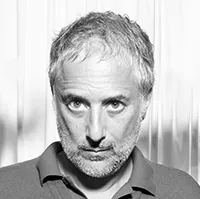
Harmony Korine, American, b. 1973
Rooted in modern American grotesquerie, the work of Miami-based artist and filmmaker Harmony Korine has proven influential and divisive in equal measure. A lover of slapstick and vaudeville, he coined the term “mistakism” to describe his deployment of wayward aesthetics and non sequitur wit. Korine’s early appearances as a guest on The Late Show with David Letterman, introducing startled television viewers to a confrontational master of everyday beauty and repulsion, are the stuff of legend. In his paintings, drawings, assemblages, and movies, backwoods surrealism and narcotic abstraction collide to produce a perverse, disorienting vision.
Born in Bolinas, California, in 1973, Korine was raised on a commune before moving with his family to North Africa and settling, at age seven, in Nashville, Tennessee. Having started making art as a teenager—he once painted, at the car wash where he worked, a neon dragon inside Roy Orbison’s trunk—Korine attended film school at New York University. An encounter with photographer and filmmaker Larry Clark let him to write the screenplay for Clark’s controversial movie Kids (1995). He went on to direct Gummo (1997) and Julien Donkey-Boy (1999) before spending much of the next eight years “mowing lawns and shooting guns,” emerging only to write Clark’s 2002 feature Ken Park. Korine returned to directing in 2007 with Mister Lonely (codirected with his brother Avi Korine), also writing and directing Trash Humpers (2009), Spring Breakers (2012), and The Beach Bum (2019).
In 2004, Korine’s artwork was included in Beautiful Losers: Contemporary Art and Street Culture, which traveled through 2009 from the Contemporary Arts Center, Cincinnati, to venues throughout the US and Europe. The exhibition featured Korine’s work alongside that of other artists, including Mark Gonzales, Barry McGee, and Chris Johanson, to whom the youth subcultures of skateboarding and graffiti were of critical significance. Also in 2009, Korine was the subject of an important solo exhibition, Pigxote, at Vanderbilt University Fine Arts Gallery, Nashville. The following years saw him exhibit periodically, with a major survey exhibition of his work taking place at the Centre Pompidou, Paris, in 2017.
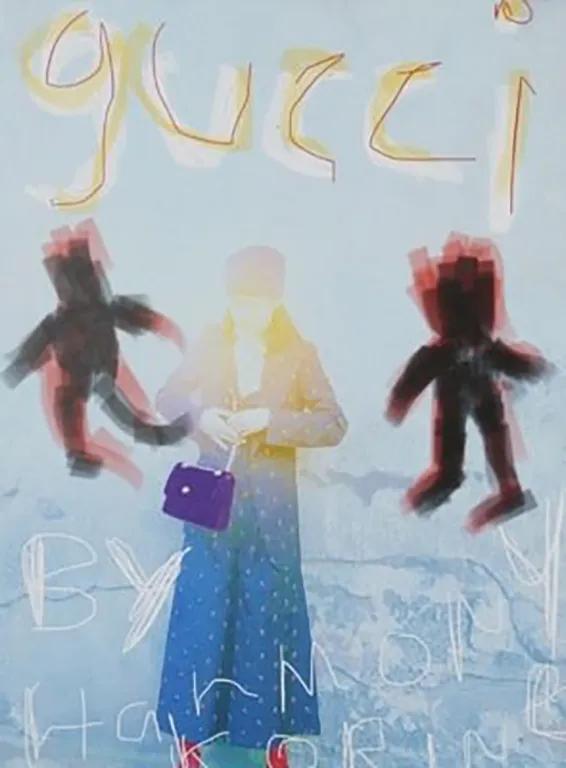
In paintings and mixed-media works that incorporate materials such as leftover household emulsion and old videotapes, Korine mirrors the deliberate confusion of staging and improvisation that characterizes his films, producing designs and images united by their hypnotic restlessness. In works that range from the swirling psychedelic grids of the Checking Madness series (2014) to those on display in his 2019 exhibition Young Twitchy, in which he fused photo-based and hand-drawn imagery, he is consistently driven by memory, emotion, and sensation as opposed to rational thought.
In the “fazor” paintings of 2016, Korine employs allover patterning to generate compositions in which repetition and looping, or “phasing,” generates a trancelike physiological reaction, an unmistakably psychotropic edge. In BLOCKBUSTER, a series of paintings from 2018, he makes more explicit reference to film by repurposing VHS cassettes and boxes acquired from a Nashville branch of the now-defunct titular rental chain, arranging them into grids and altering their covers, often by adding renderings of his ghostlike “friend” icon. Riffing off forgotten plots and actors, these works reflect with affection on a realm that is “nearly obsolete, lost in the fog of analog.”
Such projects join Korine’s efforts in other media—these include A Crackup at the Race Riots (Mainstreet/Doubleday, 1998), the artist’s attempt to write “the Great American Choose-Your-Own-Adventure Novel”—to reinforce an ongoing but aesthetically consistent movement between forms and genres. “It all comes from the same place, inside me,” he says, “and it’s all speaking the same language.”
