

Which art books, prints and posters are available by and about this artist? Here is a sample of items of interest to a typical collector:

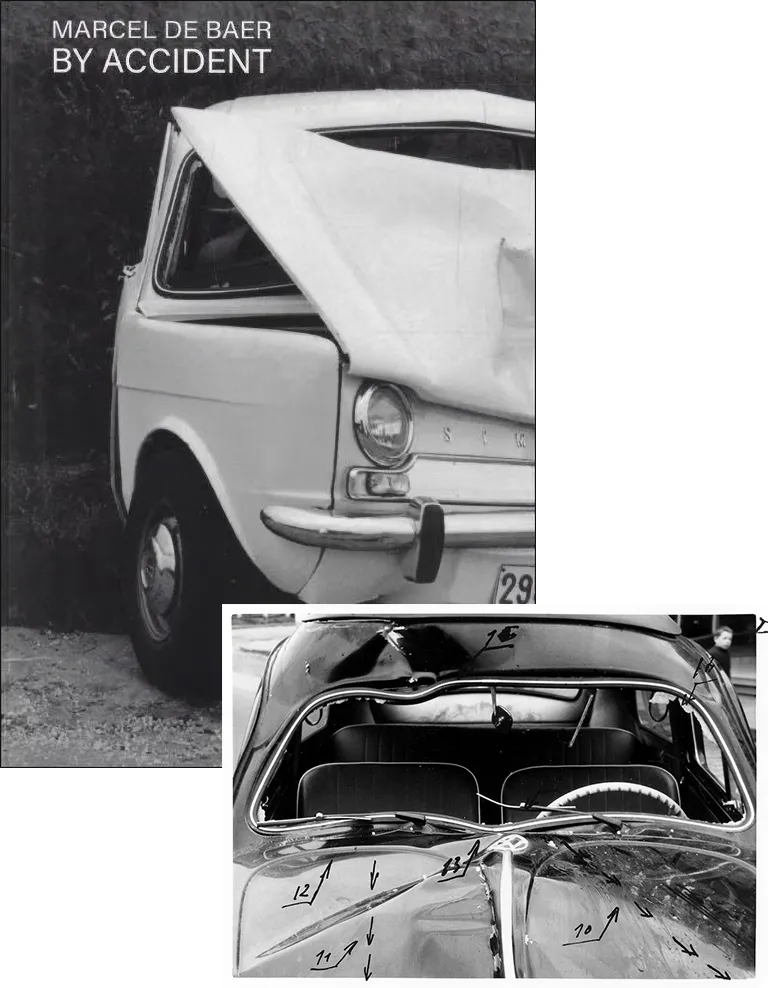
Marcel De Baer served as a forensic expert and accident investigator for the public prosecutor's office during the 1960s and 1970s, meticulously documenting traffic collisions and road accidents across Belgium. Operating entirely within the realm of legal documentation rather than fine art photography, his professional output consisted of thousands of clinical scene records captured to provide definitive, impartial evidence for magistrates and court proceedings. Without artistic intent, his camera focused squarely on the material evidence of impact: tire skid marks, vehicular structural deformation, shattered glass, oil pools, and hand-drawn chalk trajectories.
Within the context of contemporary vernacular archives and typological image-making, De Baer's operational archive has come to be recognized for its inadvertent formalist power. The clinical neutrality of his perspective, combined with the physical overlay of handwritten administrative notes, sequential case numbers, and geometric vector lines inscribed directly onto the photographic prints, transforms utilitarian legal records into striking abstract artifacts. This friction between objective forensic documentation and unintended visual poetry positions his work as a compelling examination of how evidentiary traces of disaster can yield structural and compositional resonance.


see book page for more details
By Accident, collecting the forensic photography archive of Marcel De Baer, presents an extraordinary intersection between utilitarian legal documentation and unintentional visual poetry. Operating as a forensic expert specializing in traffic collisions and road accidents for the public prosecutor's office during the 1960s and 1970s, De Baer systematically recorded thousands of crash sites to provide clear, factual evidence for judges and juries. Rather than seeking artistic expression, his lens focused strictly on skid marks, vehicular damage, structural scratches, chalk outlines, and physical debris, distilling chaotic moments into clinical, unembellished records.
Stripped of sensationalism and direct human tragedy, these images acquire a striking formalist resonance when isolated as photographic objects. The visual components, comprising graphic arrows, handwritten annotations, sequential numbers, and stark geometric marks painted or drawn over the physical prints, overlay an abstract layer onto the stark traces of impact. This interplay between objective state documentation and inadvertent graphic composition positions the archive within a wider lineage of vernacular typology, examining how indexical records of violence and disruption can inadvertently manifest profound aesthetic structure.
This is the limited edition of the book with an estate-stamped print released in an edition of 100.