
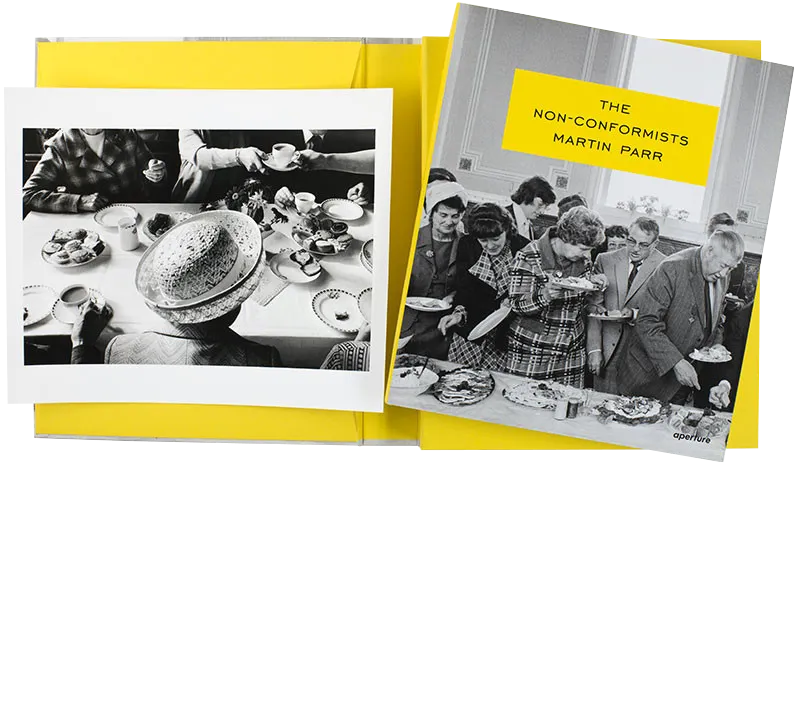


This is the limited edtion of the book with a signed print.
In 1975, fresh out of art school, Martin Parr moved to the picturesque Yorkshire Pennine mill town of Hebden Bridge. For five years, he documented the town in photographs, showing, in particular, the aspects of traditional life that were beginning to decline. Susan Mitchell, whom he has met in Manchester and later married, joined Parr in documenting a year in the life of a small Methodist chapel, together with its farming community. Such chapels seemed to encapsulate the region's disappearing way of life. Here, Martin Parr found his photographic voice, while together, he and Susie assembled a remarkable and touching historical document ' now published in book form for the first time. The book takes its title from the Methodist and Baptist chapels that then characterized this area of Yorkshire and defined the fiercely independent character of the town. Non-Conformist Methodists reject the tenets of state Anglicism, and the Non-Conformist chapel of Hebden Bridge is central to the town and its community. In words and pictures, the Parrs vividly and affectionately document cobbled streets, flat-capped mill workers, hardy gamekeepers, henpecked husbands, and jovial shop owners. The best Parr photographs are interwoven with Susie Parr's detailed background descriptions of their observed society.

This is the limited edtion of the book with a signed print.
In 1975, fresh out of art school, Martin Parr moved to the picturesque Yorkshire Pennine mill town of Hebden Bridge. For five years, he documented the town in photographs, showing, in particular, the aspects of traditional life that were beginning to decline. Susan Mitchell, whom he has met in Manchester and later married, joined Parr in documenting a year in the life of a small Methodist chapel, together with its farming community. Such chapels seemed to encapsulate the region's disappearing way of life. Here, Martin Parr found his photographic voice, while together, he and Susie assembled a remarkable and touching historical document ' now published in book form for the first time. The book takes its title from the Methodist and Baptist chapels that then characterized this area of Yorkshire and defined the fiercely independent character of the town. Non-Conformist Methodists reject the tenets of state Anglicism, and the Non-Conformist chapel of Hebden Bridge is central to the town and its community. In words and pictures, the Parrs vividly and affectionately document cobbled streets, flat-capped mill workers, hardy gamekeepers, henpecked husbands, and jovial shop owners. The best Parr photographs are interwoven with Susie Parr's detailed background descriptions of their observed society.