SOLD
Copyright ©
Andreas Gursky
or applicable right holders.
Poster




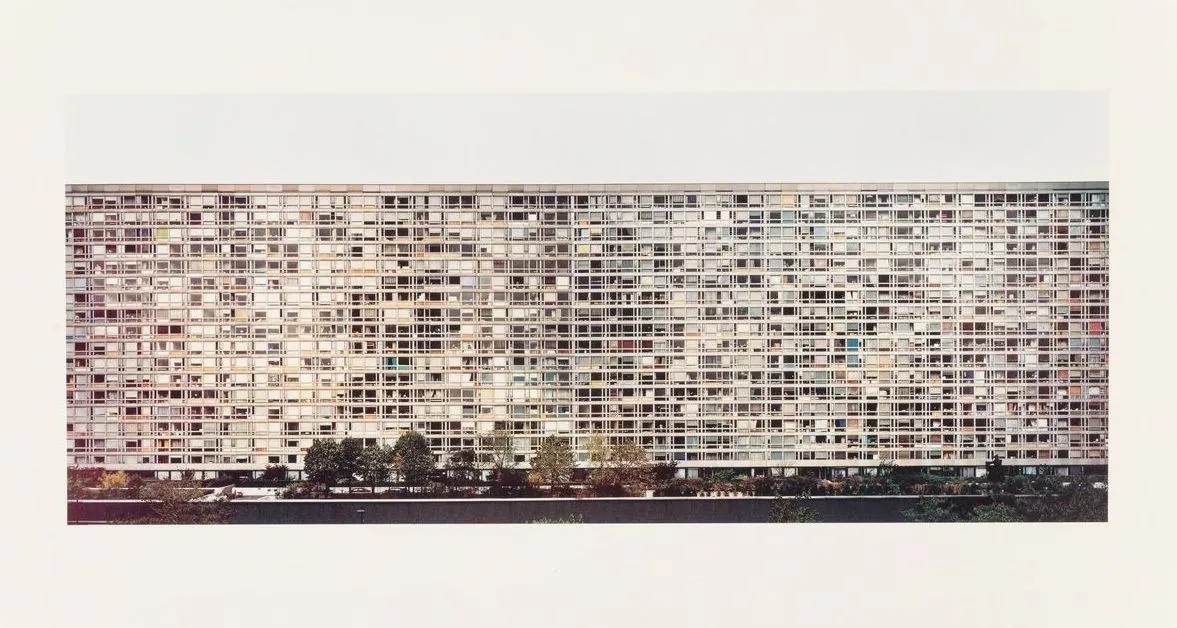
Andreas Gursky’s Paris, Montparnasse (1993) represents a paradigm shift in contemporary photography, signaling the artist's definitive embrace of digital manipulation to construct hyper-real, impossible perspectives. Depicting the Immeuble Maine-Montparnasse, a massive modernist housing estate designed by Jean Dubuisson, the work transcends mere architectural documentation to offer a sweeping commentary on late-capitalist globalization, mass society, and the overwhelming scale of the modern urban environment. Within Gursky’s oeuvre, this project marked his transition away from straightforward, single-exposure observation toward the meticulously engineered, large-scale tableaux that would come to define his career and solidify his legacy.
Aesthetically, the image is defined by its unrelenting, grid-like composition and an all-over focus that denies the viewer a central point of rest. By digitally stitching together two large-format negatives captured from separate vantage points, Gursky eliminated natural perspectival distortion, achieving a flat, edge-to-edge sharpness that feels both god-like and coldly objective. This rigorous structural framework transforms the chaotic, lived reality of hundreds of individual domestic spaces into a synchronized, abstract pattern of color and geometry. The sheer density of the building’s facade swallows the human element, reducing the residents to tiny, anonymous details within a vast, mathematically precise matrix.
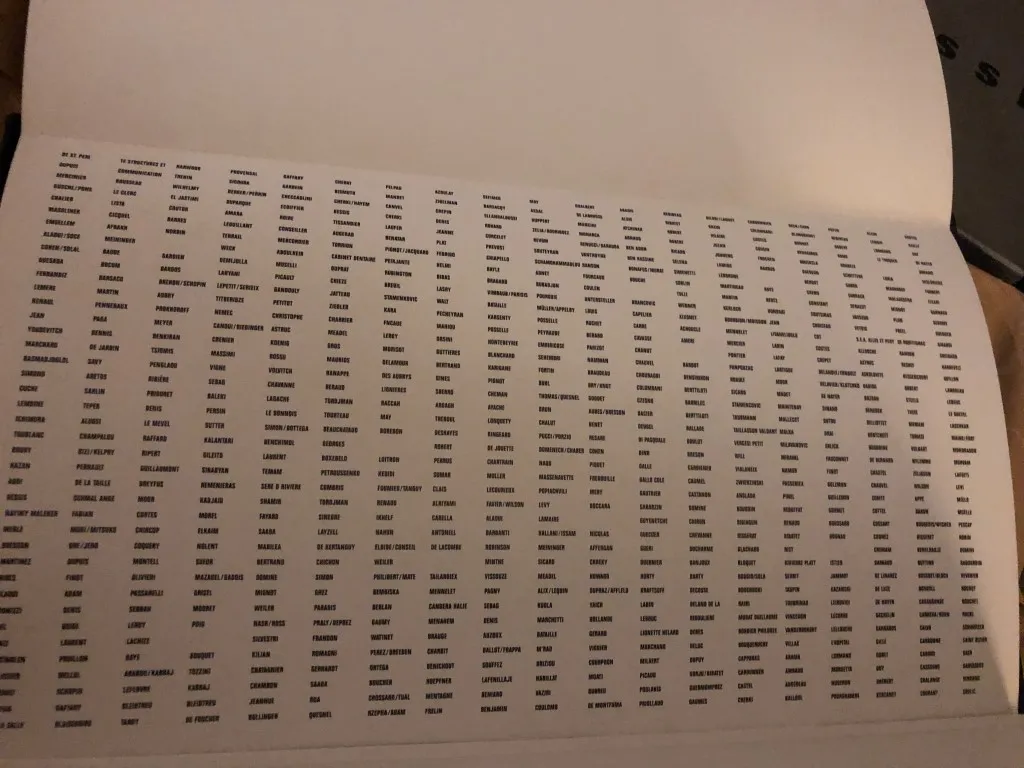
This specific edition was printed with the limited edition book Montparnasse.
Andreas Gursky’s Paris, Montparnasse (1993) represents a paradigm shift in contemporary photography, signaling the artist's definitive embrace of digital manipulation to construct hyper-real, impossible perspectives. Depicting the Immeuble Maine-Montparnasse, a massive modernist housing estate designed by Jean Dubuisson, the work transcends mere architectural documentation to offer a sweeping commentary on late-capitalist globalization, mass society, and the overwhelming scale of the modern urban environment. Within Gursky’s oeuvre, this project marked his transition away from straightforward, single-exposure observation toward the meticulously engineered, large-scale tableaux that would come to define his career and solidify his legacy.
Aesthetically, the image is defined by its unrelenting, grid-like composition and an all-over focus that denies the viewer a central point of rest. By digitally stitching together two large-format negatives captured from separate vantage points, Gursky eliminated natural perspectival distortion, achieving a flat, edge-to-edge sharpness that feels both god-like and coldly objective. This rigorous structural framework transforms the chaotic, lived reality of hundreds of individual domestic spaces into a synchronized, abstract pattern of color and geometry. The sheer density of the building’s facade swallows the human element, reducing the residents to tiny, anonymous details within a vast, mathematically precise matrix.
This specific edition was printed with the limited edition book Montparnasse.


Andreas Gursky’s Paris, Montparnasse (1993) represents a paradigm shift in contemporary photography, signaling the artist's definitive embrace of digital manipulation to construct hyper-real, impossible perspectives. Depicting the Immeuble Maine-Montparnasse, a massive modernist housing estate designed by Jean Dubuisson, the work transcends mere architectural documentation to offer a sweeping commentary on late-capitalist globalization, mass society, and the overwhelming scale of the modern urban environment. Within Gursky’s oeuvre, this project marked his transition away from straightforward, single-exposure observation toward the meticulously engineered, large-scale tableaux that would come to define his career and solidify his legacy.
Aesthetically, the image is defined by its unrelenting, grid-like composition and an all-over focus that denies the viewer a central point of rest. By digitally stitching together two large-format negatives captured from separate vantage points, Gursky eliminated natural perspectival distortion, achieving a flat, edge-to-edge sharpness that feels both god-like and coldly objective. This rigorous structural framework transforms the chaotic, lived reality of hundreds of individual domestic spaces into a synchronized, abstract pattern of color and geometry. The sheer density of the building’s facade swallows the human element, reducing the residents to tiny, anonymous details within a vast, mathematically precise matrix.
This specific edition was printed with the limited edition book Montparnasse.