SOLD
Copyright ©
Hans Christian Schink
or applicable right holders.
Poster



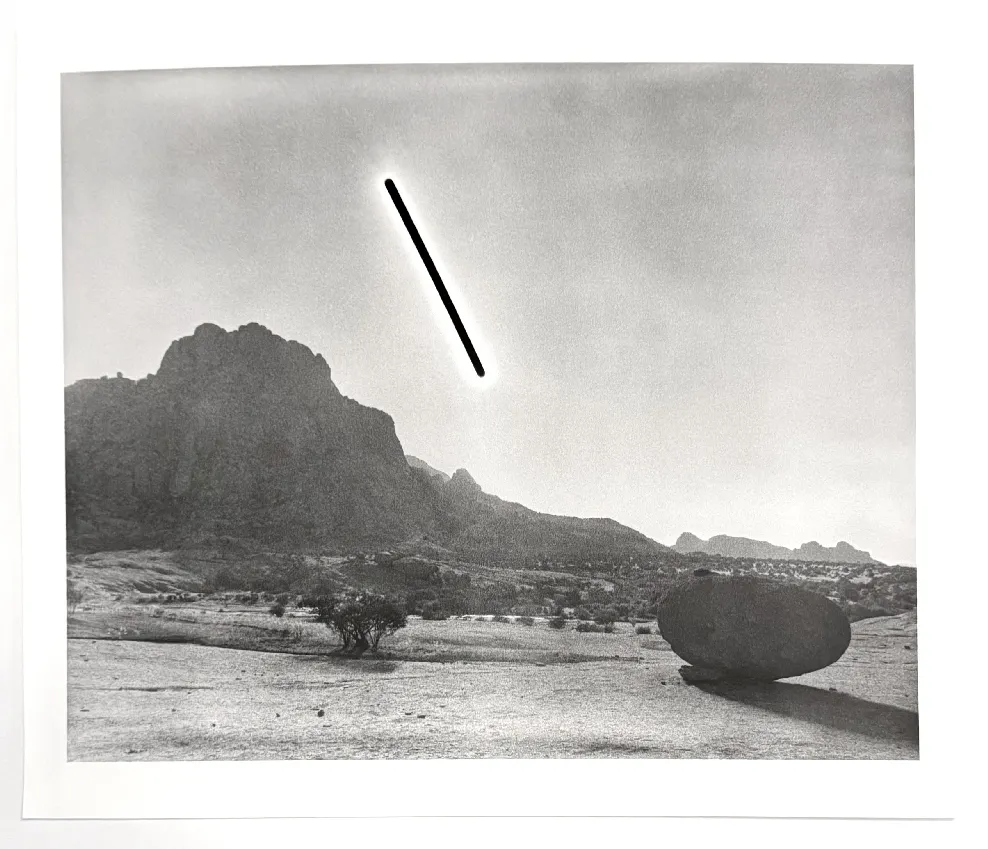

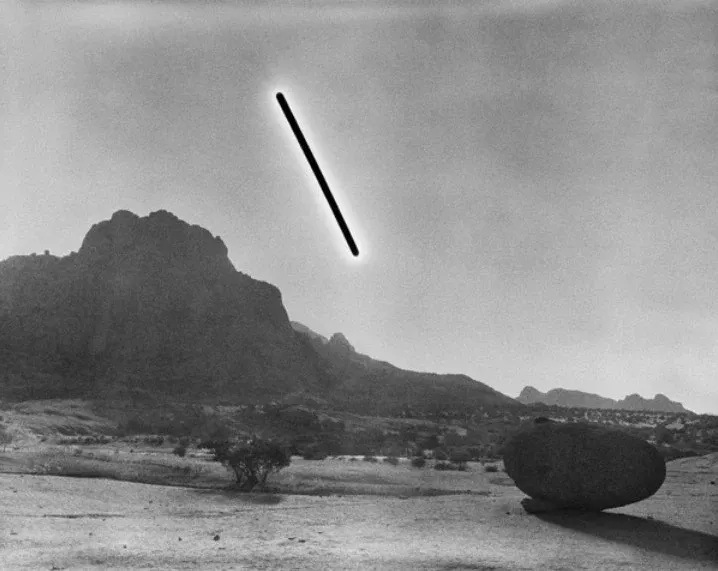
Hans Christian Schink’s 4/13/2009, 7:09 - 8:09 am, S 21°47.150’ E 015°39.893’ belongs to his monumental 1h series, a conceptual investigation into the passage of time and the mechanical recording of celestial mechanics. By exposing large-format film for precisely one hour, Schink transforms the camera from a tool of instant documentation into a durational apparatus that captures the Earth's rotation. Grounded in a desolate landscape mapped only by strict GPS coordinates and precise timestamps, this project strips away traditional romantic notions of landscape photography, replacing them with a rigorous, objective approach to the natural world.
Aesthetically, the work is anchored by its extraordinary technical execution, specifically its reliance on the Schwarzschild effect, or true solarization. Due to the extreme, sustained overexposure of the sun's trajectory across the film plane, the brightest point in the sky chemically reverses, rendering the sun's path as a dense, graphic black arc. This intense, opaque line carves through the pale, luminous sky and the quiet, static terrain below. The resulting composition offers a striking structural contrast, pitting the slow, organic weathering of the earth against the precise, mechanical geometry of the solar track.
By translating an hour of cosmic movement into a permanent, flat archival print, Schink collapses time and volume into a singular visual object.



Hans Christian Schink’s 4/13/2009, 7:09 - 8:09 am, S 21°47.150’ E 015°39.893’ belongs to his monumental 1h series, a conceptual investigation into the passage of time and the mechanical recording of celestial mechanics. By exposing large-format film for precisely one hour, Schink transforms the camera from a tool of instant documentation into a durational apparatus that captures the Earth's rotation. Grounded in a desolate landscape mapped only by strict GPS coordinates and precise timestamps, this project strips away traditional romantic notions of landscape photography, replacing them with a rigorous, objective approach to the natural world.
Aesthetically, the work is anchored by its extraordinary technical execution, specifically its reliance on the Schwarzschild effect, or true solarization. Due to the extreme, sustained overexposure of the sun's trajectory across the film plane, the brightest point in the sky chemically reverses, rendering the sun's path as a dense, graphic black arc. This intense, opaque line carves through the pale, luminous sky and the quiet, static terrain below. The resulting composition offers a striking structural contrast, pitting the slow, organic weathering of the earth against the precise, mechanical geometry of the solar track.
By translating an hour of cosmic movement into a permanent, flat archival print, Schink collapses time and volume into a singular visual object.