SOLD
Copyright ©
Harry Gruyaert
or applicable right holders.
Poster



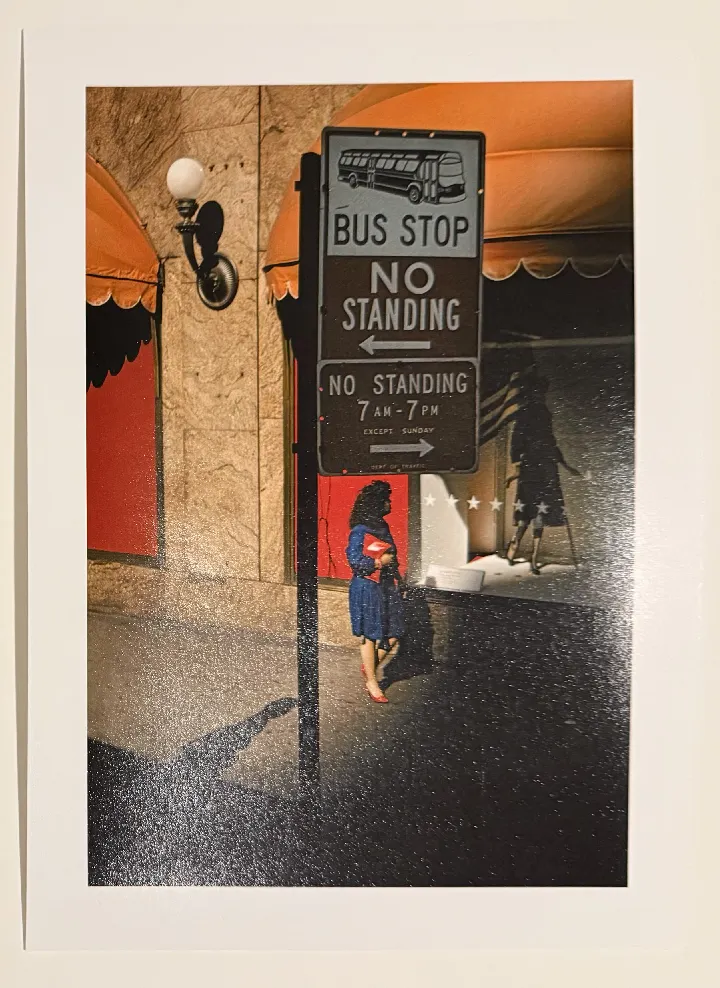
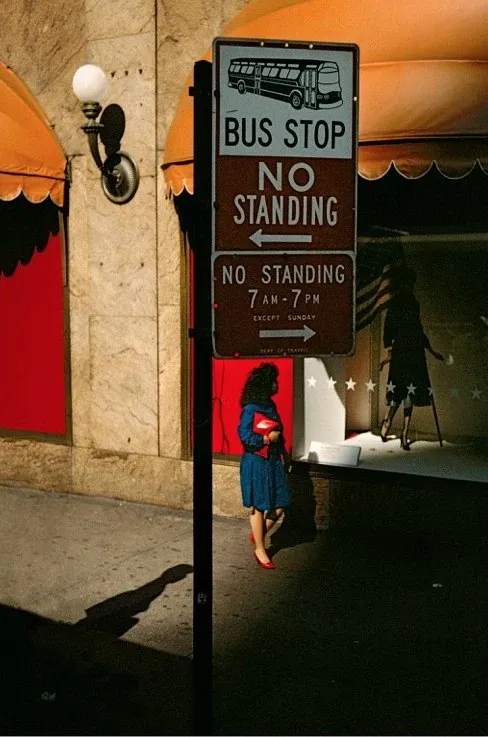
Harry Gruyaert’s USA, New York City (1985) serves as a compelling study in chromatic architecture, dense spatial framing, and urban isolation. Created during a period when Gruyaert was actively documenting the American urban landscape, the image captures New York not through traditional narrative photojournalism, but as a complex visual tapestry defined by saturated hues, dramatic directional light, and geometric balance. By isolating figures within deep architectural shadows and vibrant artificial reflections, Gruyaert transforms the frantic energy of mid-80s Manhattan into a suspended, almost cinematic atmosphere where color functions as the primary structural element.
The visual composition relies on a sophisticated interweaving of scale, surface reflection, and spatial layering. Gruyaert leverages the tactile, rich tonal qualities of the C-print medium to emphasize deep blacks alongside luminous primary colors, treating the urban environment as an abstract graphic plane. The framing creates a subtle friction between the human presence and the overwhelming scale of the surrounding architecture, drawing the viewer’s eye through intersecting lines, glass reflections, and hard-edged shadows that dissolve the boundaries between background and foreground.


Harry Gruyaert’s USA, New York City (1985) serves as a compelling study in chromatic architecture, dense spatial framing, and urban isolation. Created during a period when Gruyaert was actively documenting the American urban landscape, the image captures New York not through traditional narrative photojournalism, but as a complex visual tapestry defined by saturated hues, dramatic directional light, and geometric balance. By isolating figures within deep architectural shadows and vibrant artificial reflections, Gruyaert transforms the frantic energy of mid-80s Manhattan into a suspended, almost cinematic atmosphere where color functions as the primary structural element.
The visual composition relies on a sophisticated interweaving of scale, surface reflection, and spatial layering. Gruyaert leverages the tactile, rich tonal qualities of the C-print medium to emphasize deep blacks alongside luminous primary colors, treating the urban environment as an abstract graphic plane. The framing creates a subtle friction between the human presence and the overwhelming scale of the surrounding architecture, drawing the viewer’s eye through intersecting lines, glass reflections, and hard-edged shadows that dissolve the boundaries between background and foreground.