SOLD
Copyright ©
Ralph Steiner
or applicable right holders.
Poster



Other impressions of this image are in the permanent collections of MOMA, NY (Object 640.1970) and The Metropolitan Museum, NY (Object # 1987.1100.277).
Other impressions of this image are in the permanent collections of MOMA, NY (Object 640.1970) and The Metropolitan Museum, NY (Object # 1987.1100.277).
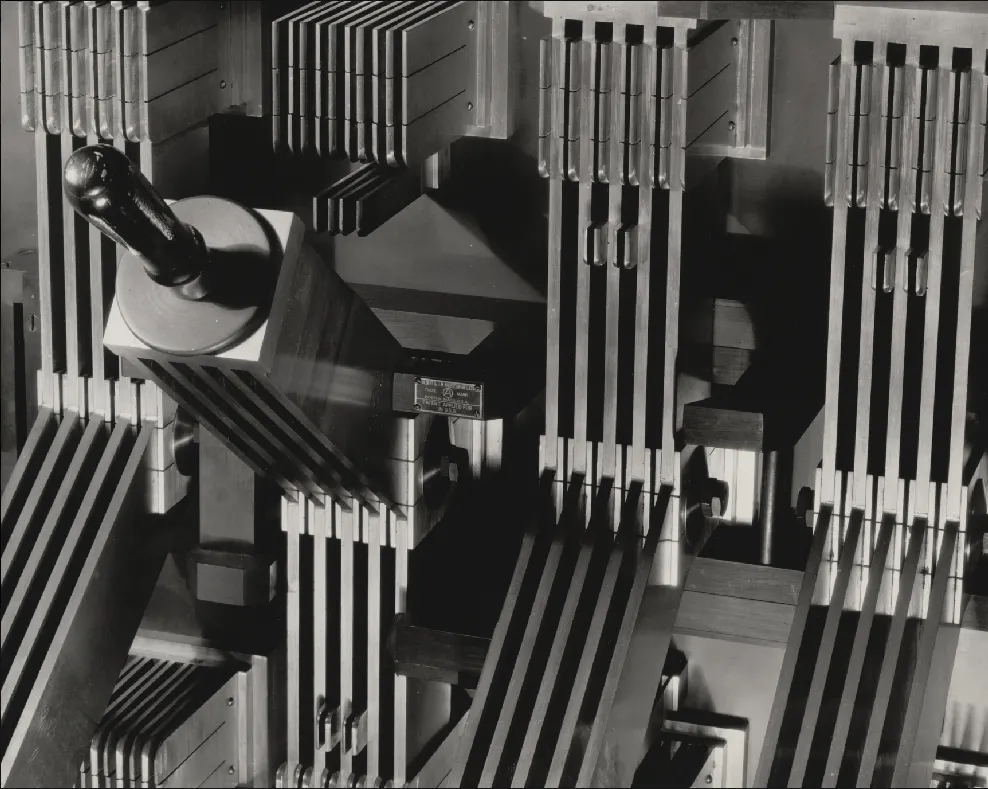
Ralph Steiner’s Power Switches stands as a defining image of American modernist photography and a quintessential celebration of the machine age. Created during a period when Steiner definitively abandoned the soft-focus romanticism of pictorialism, this image reflects a broader cultural fascination with industrialization and rapid technological progress. By turning his lens toward the utilitarian infrastructure of electrical power, Steiner elevates a mundane mechanical apparatus into a monument of modern engineering. This work fits squarely within his early career focus on the precise, unapologetic realities of the urban and industrial environment, aligning his practice with the sharp-focus aesthetics and rigorous objectivity of the era's avant-garde.
Aesthetically, the print is a masterclass in graphic clarity and complex spatial organization. Steiner isolates the rhythmic, repeating forms of the heavy insulators and metal switchblades against a flattened background, deliberately stripping away any distracting environmental context. He employs a deep focal plane and stark, dramatic tonal contrasts to transform the three-dimensional machinery into a tightly woven, abstract puzzle of light and shadow. The aggressive cropping forces the viewer to confront the sculptural geometry of the object itself, emphasizing the gleaming textures of industrial metal and the sheer mechanical heft of the components without relying on traditional narrative.
Other impressions of this image are in the permanent collections of MOMA, NY (Object 640.1970) and The Metropolitan Museum, NY (Object # 1987.1100.277).


Ralph Steiner’s Power Switches stands as a defining image of American modernist photography and a quintessential celebration of the machine age. Created during a period when Steiner definitively abandoned the soft-focus romanticism of pictorialism, this image reflects a broader cultural fascination with industrialization and rapid technological progress. By turning his lens toward the utilitarian infrastructure of electrical power, Steiner elevates a mundane mechanical apparatus into a monument of modern engineering. This work fits squarely within his early career focus on the precise, unapologetic realities of the urban and industrial environment, aligning his practice with the sharp-focus aesthetics and rigorous objectivity of the era's avant-garde.
Aesthetically, the print is a masterclass in graphic clarity and complex spatial organization. Steiner isolates the rhythmic, repeating forms of the heavy insulators and metal switchblades against a flattened background, deliberately stripping away any distracting environmental context. He employs a deep focal plane and stark, dramatic tonal contrasts to transform the three-dimensional machinery into a tightly woven, abstract puzzle of light and shadow. The aggressive cropping forces the viewer to confront the sculptural geometry of the object itself, emphasizing the gleaming textures of industrial metal and the sheer mechanical heft of the components without relying on traditional narrative.