

Copyright ©
Damien Hirst
or applicable right holders.


Which art books, prints and posters are available by and about this artist? Here is a sample of items of interest to a typical collector:





Damien Hirst, British, b. 1965, emerged in the late 1980s as the leading figure of the Young British Artists, fundamentally reshaping contemporary art through his meditations on mortality, science, and the commodification of the art object. Moving past traditional painting and sculpture, his practice frequently employs pharmaceutical displays, surgical instruments, and biological specimens to create stark, clinical observations of life and death. By treating medicine and science as modern belief systems, he constructs highly organized visual frameworks that balance clinical detachment with existential vulnerability.
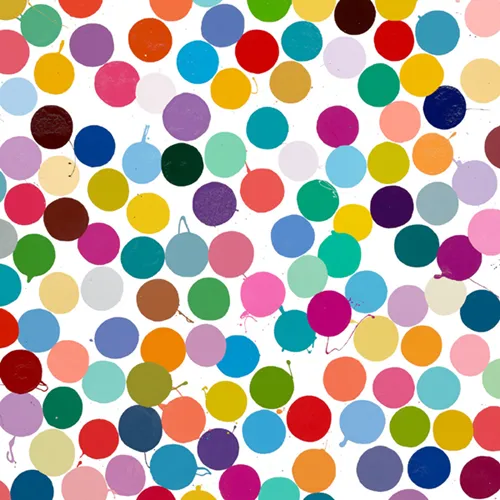
Throughout his career, Hirst’s output has been defined by several major, overlapping bodies of work. His Natural History series, which dominated his output in the 1990s, introduced his use of biological specimensmost notably sharks, sheep, and cows, suspended in tanks of formaldehyde. These monumental vitrines function as rigorous structural inquiries into the systems used to categorize and preserve the physical form. Running concurrently since the late 1980s, his Spot Paintings and glass Medicine Cabinets explore seriality and the seductive power of pharmaceuticals, replacing the artist's hand with mechanical precision and systematic color arrangements. In the late 1990s and 2000s, his focus expanded to include kaleidoscopic butterfly wing compositions and kinetic spin paintings, juxtaposing the vibrant energy of life with the inevitability of death. By the mid-2000s, his practice incorporated extreme luxury materials, epitomized by his diamond-encrusted platinum skull, For the Love of God (2007), which pushed his critique of materialism, wealth, and the global art market to its absolute limits.
Aesthetically, Hirst's overarching visual language relies heavily on systematic repetition, grid-like precision, and the sterile presentation of consumer and medical goods. Whether organizing pills on a shelf or spacing perfectly round spots on a canvas, his calculated detachment transforms chaotic, organic realities into contained, highly controlled formalist constructions.

→