

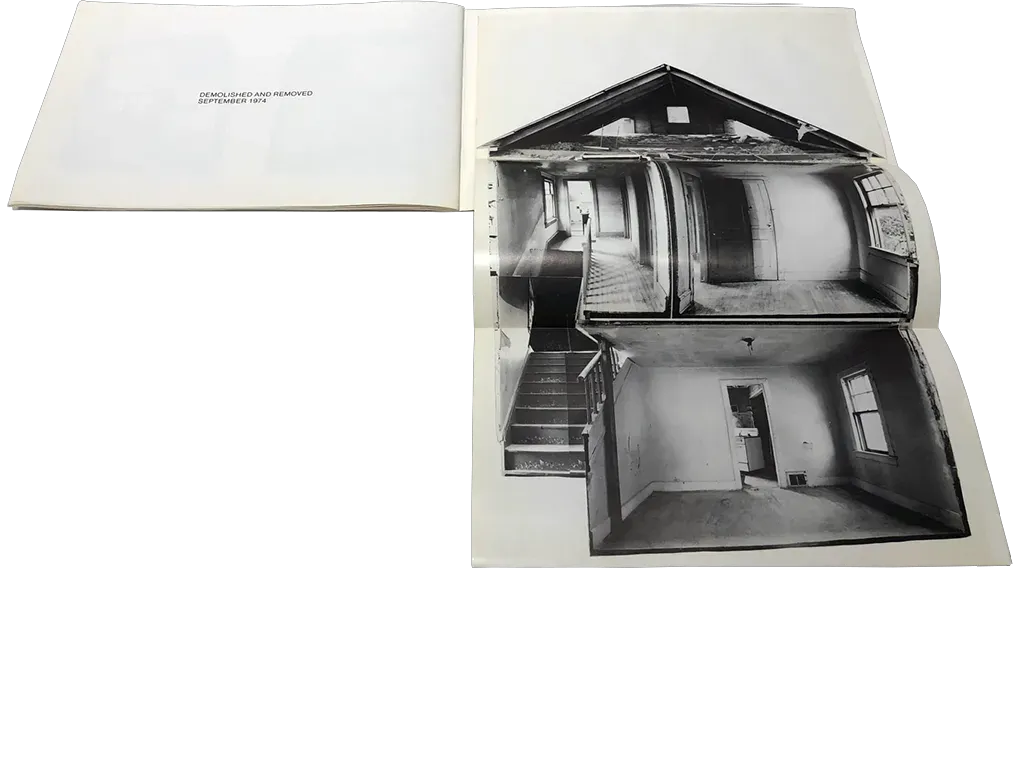
Staple-bound softcover with foldout on the last page.
ISBN:


Which art books, prints and posters are available by and about this artist? Here is a sample of items of interest to a typical collector:

%20copy.webp)
Gordon Matta-Clark, American (1943–1978)
A central figure of the downtown New York art scene in the 1970s, Matta-Clark pioneered a radical approach to art making that directly engaged the urban environment and the communities within it. Through his many projects—including large-scale architectural interventions in which he physically cut through buildings slated for demolition—Matta-Clark developed a singular and prodigious oeuvre that critically examined the structures of the built environment. With actions and experimentations across a wide range of media, his work transcended the genres of performance, conceptual, process, and land art, making him one of the most innovative and influential artists of his generation.
In 1985, the first museum retrospective of Matta-Clark's work was presented at the Museum of Contemporary Art Chicago, and traveled until 1989 to over a dozen institutions internationally, including the Stedelijk Museum, Amsterdam; Kunsthalle Basel; Le Nouveau Musée, Villeurbanne, France; Brooklyn Museum, New York; and the Musée d'art contemporain de Montréal. In 1997, the Generali Foundation, Vienna, prepared the first comprehensive overview dedicated to the artist's drawing practice, consisting of over six hundred works on paper. It toured through 2000 to the Museu d'Art Contemporani de Barcelona; Institute for Art and Urban Resources at P.S. 1, New York; and the Westfälisches Landesmuseum für Kunst und Kulturgeschichte, Münster, Germany.
In 2007, Gordon Matta-Clark: You Are the Measure was the first full-scale retrospective organized by the Whitney Museum of American Art, New York, which traveled to the Museum of Contemporary Art, Los Angeles, and the Museum of Contemporary Art Chicago. From 2009 to 2010, Gordon Matta-Clark: Undoing Spaces—the first major survey of his work in South America—toured to the Museo Nacional de Bellas Artes, Santiago; Museu de Arte Moderna, São Paulo; Paco Imperial, Rio de Janeiro; and Museo de Arte de Lima. Recent institutional exhibitions were held at Museu Serralves, Porto(2017), and The National Museum of Modern Art, Tokyo (2018), which marked the first full-scale retrospective of the artist’s work in Asia (titled Gordon Matta-Clark: Mutations in Space). From 2017 to 2020, Matta-Clark’s work was the focus of a critically acclaimed traveling exhibition, Gordon Matta-Clark: Anarchitect, that was on view at The Bronx Museum of the Arts, New York; Jeu de Paume, Paris; Kumu Art Museum, Tallinn, Estonia; and the Rose Art Museum, Brandeis University, Waltham, Massachusetts. Power Station of Art in Shanghai presented a solo exhibition of the artist’s work entitled Passing Through Architecture: The 10 Years of Gordon Matta-Clark in 2019–2020.
Matta-Clark’s estate is represented by David Zwirner, New York and his work is included in prominent institutional collections, including The Metropolitan Museum of Art, New York; Museum of Contemporary Art Chicago; Museum of Contemporary Art, Los Angeles; The Museum of Modern Art, New York; Museum van Hedendaagse Kunst Antwerpen, Antwerp; San Francisco Museum of Modern Art; Smithsonian American Art Museum, Washington, DC; Solomon R. Guggenheim Museum, New York; Stedelijk Museum, Amsterdam; and the Whitney Museum of American Art, New York. The Gordon Matta-Clark Archive is held at the Canadian Centre for Architecture in Montreal, and includes the artist's personal correspondence, notebooks, drawings, photographs, slides, films, as well as other archival material documenting his life and work.

see book page for more details
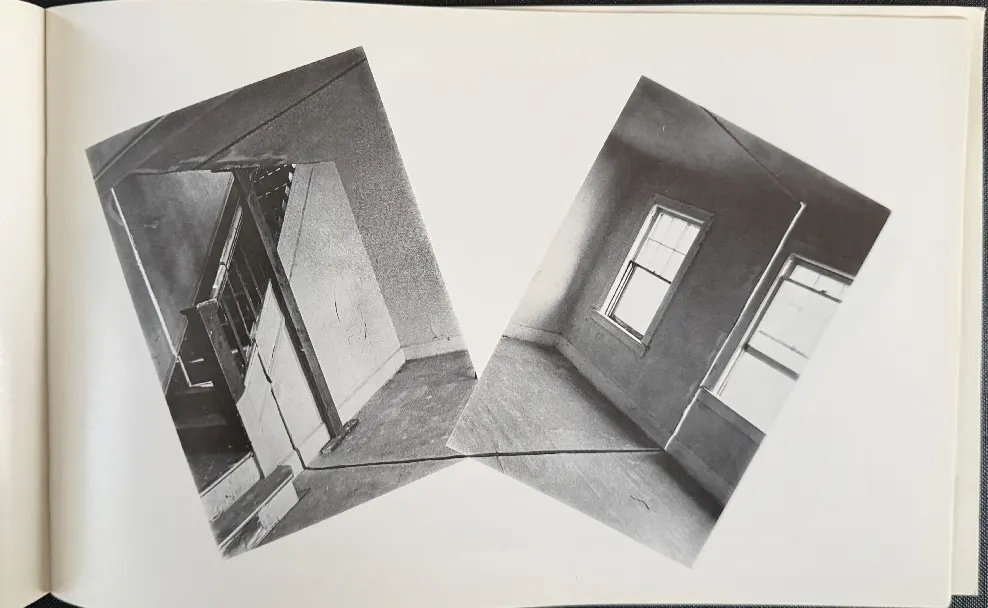
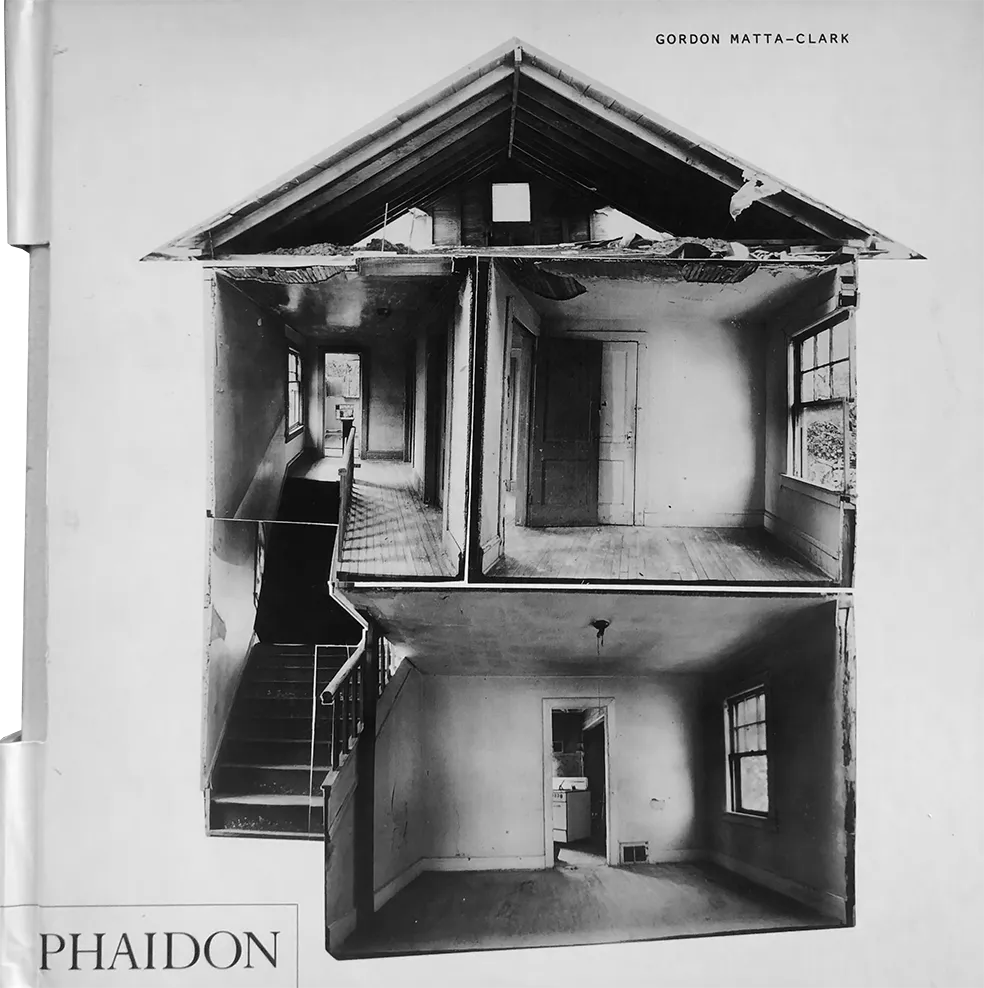
Splitting consists of photographic documentation of Matta-Clark's Splitting (1974), in which the artist made an incision down the center of a New Jersey house that had been slated for demolition, and then removed all four corners of the house's eaves. 322 Humphrey Street can be thought of as doubly cut in this work; first, in the original operation, and second, in the collage and composition of the photographs that make up the 34-page book. Sky and other backgrounds are occasionally subtracted from the photos, leaving only the white of the page where Matta-Clark made cuts in the depicted walls. In addition, the arrangement of the photos ' layered and overlapping ' creates an effect of disorientation, an impossible architecture that revolves around the axis of Matta-Clark's initial an architectural lacerations.
The text is sparse and specifies the address of the house, the dimensions of the cuts, the process of stabilizing the house, and the date of demolition and removal (September 1974). The interior back cover includes an oversized fold-out page collaged from interior photos of the rooms.