Irving Penn

Which art books, prints and posters are available by and about this artist? Here is a sample of items of interest to a typical collector:

→
Bulfinch
1997
with:
Edition:
1st
Edition size:
Out of Print
→
Moderna Museet
1996
with:
Edition:
1st
Edition size:
Out of Print
→
Apparition
1999
with:
Edition:
1st
Edition size:
Out of Print
→
Bulfinch
2001
with:
Edition:
1st
Edition size:
Out of Print
→
Harmony Books
1980
with:
Edition:
1st
Edition size:
Out of Print
→
Bulfinch
1998
with:
Edition:
1st wrm
Edition size:
Out of Print
→
MOMA
1984
with:
Edition:
1st
Edition size:
Out of Print
→

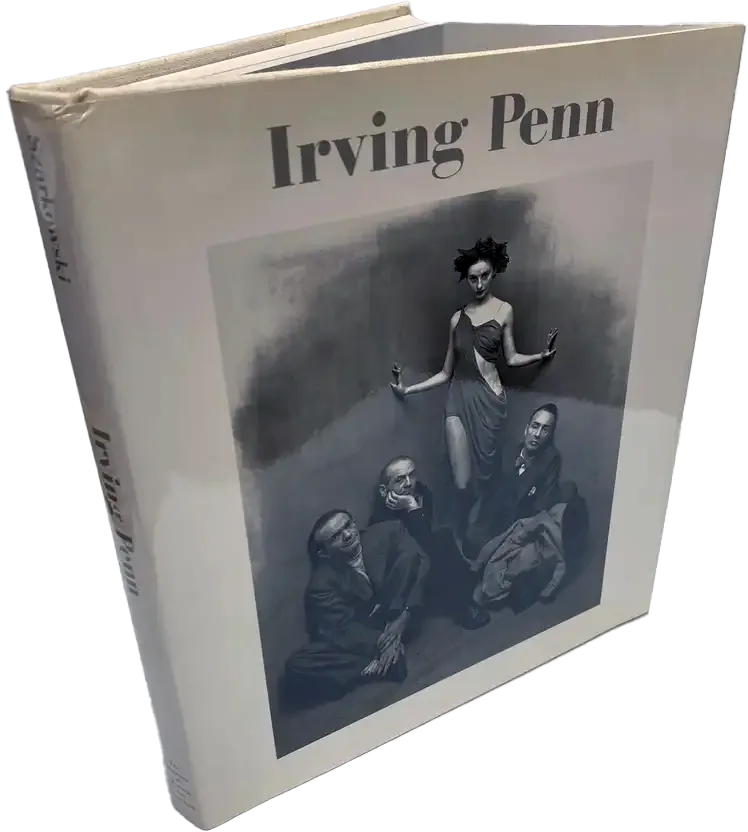
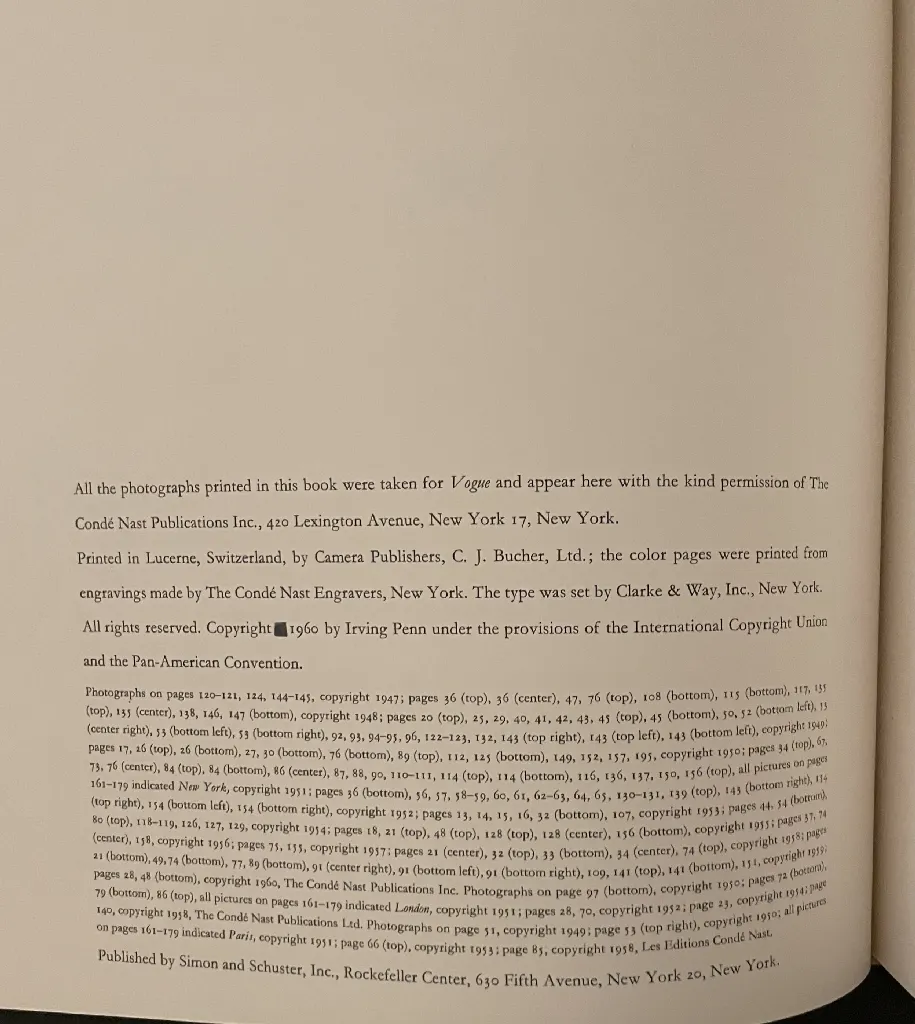
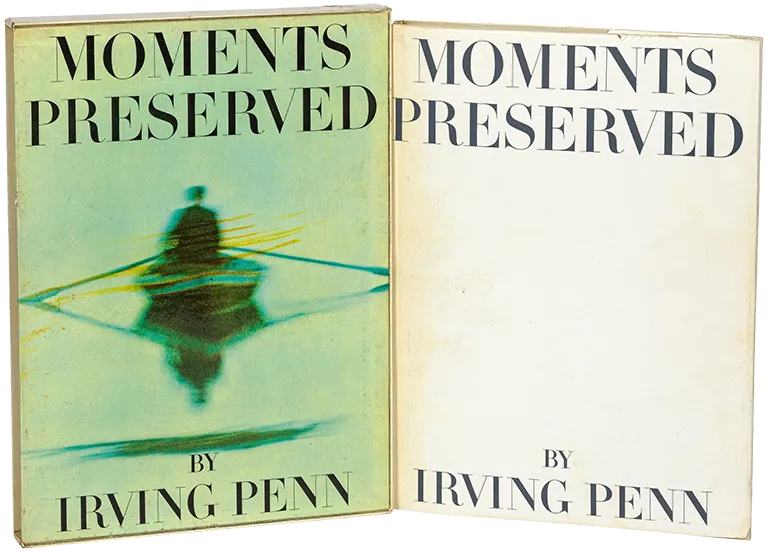
Irving Penn’s Moments Preserved, published in 1960, serves as the photographer’s inaugural monograph and a monumental summation of his early, definitive years at Vogue. Far more than a mere retrospective of editorial assignments, the book represents a critical assertion of authorship, elevating commercial fashion photography and celebrity portraiture into the realm of high art. By compiling his iconic studio portraits, fashion plates, and early ethnographic studies from Peru and Morocco into a single, cohesive volume, Penn established a democratic visual hierarchy where an haute couture model, a Peruvian child, and Pablo Picasso are all subjected to the same rigorous, uncompromising observation.

The visual language of the publication is a masterclass in graphic economy and spatial control. Penn famously strips away elaborate environmental contexts, confining his subjects against austere, mottled backdrops or within his claustrophobic, signature angled corner. This deliberate physical restriction forces the viewer into a direct, psychological confrontation with the sitter, emphasizing posture, silhouette, and the sculptural drape of fabric. The resulting compositions, rendered in both striking color and meticulously balanced black-and-white, rely on a flawless manipulation of natural studio light to carve out crisp, monumental forms from an otherwise empty void.

Simon and Schuster
1960
with:
Edition:
1st
Edition size:
Out of Print
→
Bulfinch
2004
with:
Edition:
1st
Edition size:
Out of Print
→
Museum Folkwang Essen & Steidl
2002
with:
Edition:
1st
Edition size:
Out of Print
→
Knopf
1991
with:
Edition:
1st
Edition size:
Out of Print
→
Cantz
2004
with:
Edition:
1st
Edition size:
Out of Print
→
Bulfinch
2001
with:
Edition:
1st
Edition size:
Out of Print
No items found.
No items found.
No items found.

Irving Penn, American, 1917–2009

Penn stands as one of the most exacting and influential figures in twentieth-century photography. Over a career spanning nearly seven decades, most notably defined by his monumental tenure at Vogue, Penn revolutionized commercial and fine art photography through his uncompromising pursuit of graphic perfection. He famously stripped away the elaborate, atmospheric sets favored by his predecessors, preferring to isolate his subjects against austere, neutral backdrops, frequently utilizing natural north light and his signature angled corner. This deliberate spatial confinement eliminated contextual distractions, forcing a profound psychological encounter that elevated fashion editorials and celebrity portraits into rigorous studies of form and human presence.

Penn applied this same democratic, meticulous objectivity to everything he framed. Whether photographing indigenous communities in Dahomey and New Guinea in a portable daylight studio, arranging discarded street debris and cigarette butts, or capturing the vibrant decay of fading flowers, he treated everyday objects and global figures with equal sculptural reverence. His late-career dedication to reviving and mastering the labor-intensive platinum-palladium printing process further underscored his lifelong commitment to tactile craftsmanship.

This synthesis of commercial utility and uncompromising fine art was perfectly crystallized in his foundational 1960 monograph, Moments Preserved, which compiled his fashion plates, portraits, and ethnographic studies into a single, cohesive volume, officially cementing his exacting vision within the enduring physical space of the printed page.

‍