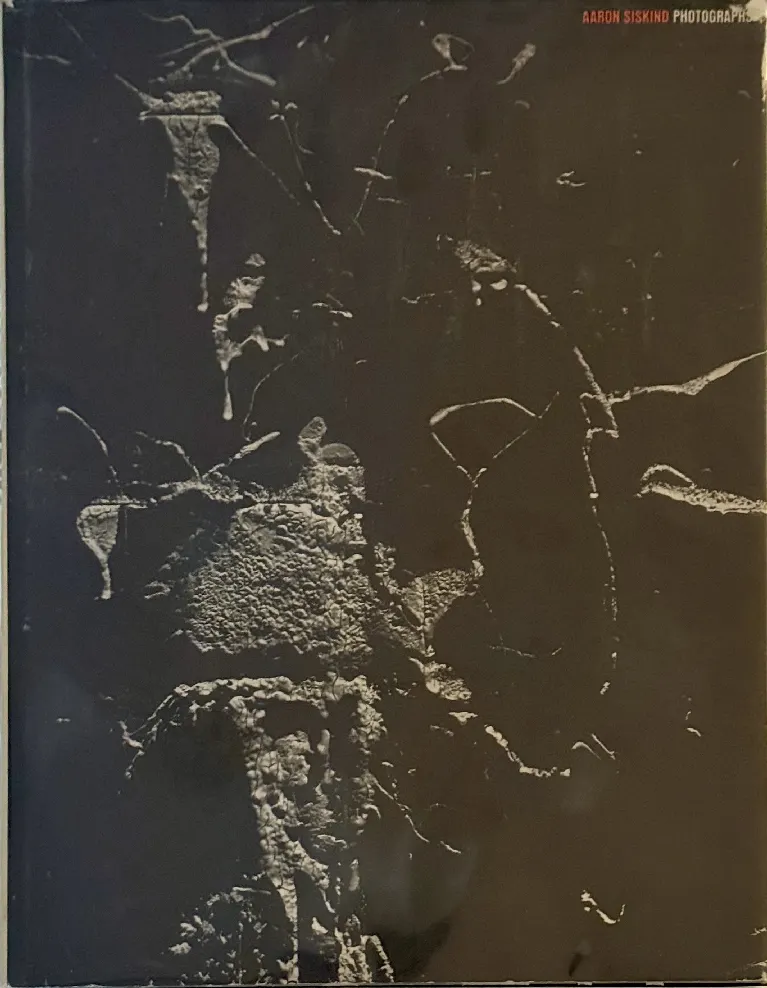
The 1959 self-titled monograph, Aaron Siskind: Photographs, published by Horizon Press, is a holy grail for a formalist collection. This was Siskind's very first monograph, and its publication marked a watershed moment in the history of the medium; it was the book that effectively forced the photographic world to accept absolute abstraction as a legitimate, autonomous fine art form.
In 1959, the photography book was almost exclusively used for documentary storytelling or sequencing narratives. Siskind and Horizon Press who brought in Chermayeff to design the book shattered this convention.
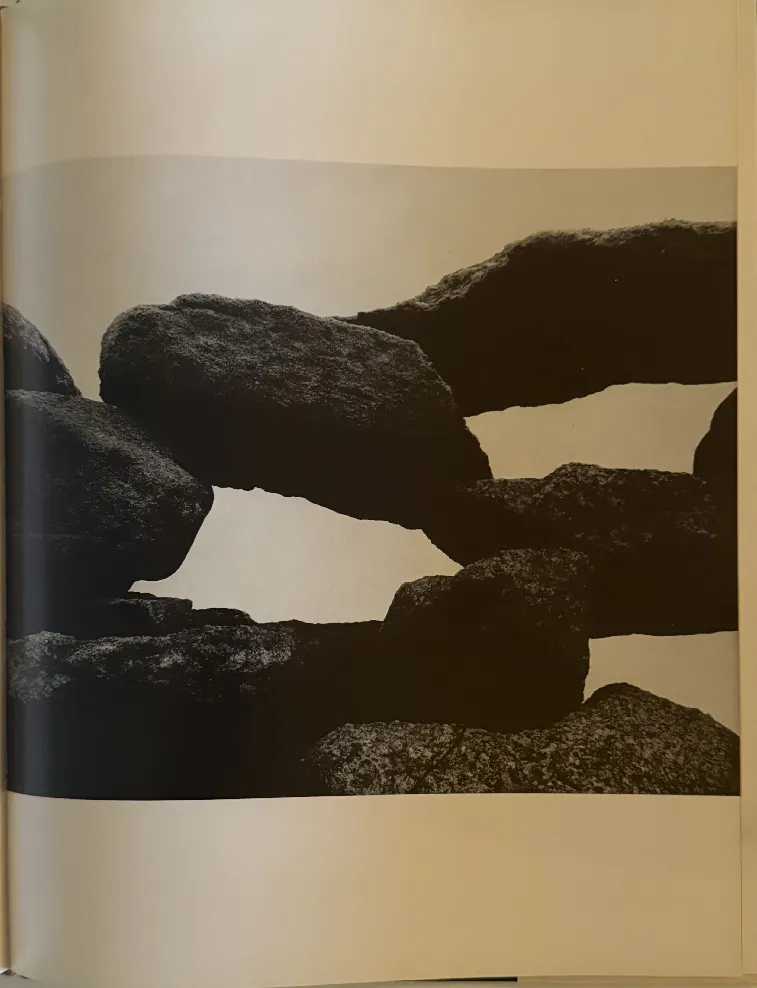
Chermayeff, who went` on to become one of the most legendary figures in American graphic design (co-founding the prominent firm Chermayeff & Geismar), brought a clean, modernist structural sensibility to the project. His design choices were instrumental in framing the book as an autonomous art object. By stripping away all text from the image pages and utilizing a bold, minimalist typographic layout for the cover and title pages, Chermayeff ensured that the viewer's focus remained entirely on the formal, two-dimensional qualities of Siskind's abstractions. The book features 50 stark, full-page plates with zero textual distraction on the image pages. It isolates his cropped frames of chipped paint, corroded metal, and weathered wood, translating three-dimensional urban detritus into purely two-dimensional graphic structures.
The production value of this first edition is incredible. It was printed using a high-quality sheet-fed gravure process that achieved deep, velvety, ink-rich blacks and a remarkably tactile surface texture. For a formalist collector, this printing method is vital: the ink sits on the heavy paper in a way that perfectly replicates the raw, gritty physical surfaces Siskind photographed, bridging the gap between the original mechanical object and the reproduced page.
Lastly, the book features a stellar introduction by the influential art critic Harold Rosenberg, a champion of Action Painting. Rosenberg's text explicitly ties Siskind's photographic frame to the canvas of the Abstract Expressionists (like Franz Kline and Willem de Kooning), cementing the idea that the camera could be used not to record an exterior scene, but to construct a self-contained visual order.





see book page for more details
The 1959 self-titled monograph, Aaron Siskind: Photographs, published by Horizon Press, is a holy grail for a formalist collection. This was Siskind's very first monograph, and its publication marked a watershed moment in the history of the medium; it was the book that effectively forced the photographic world to accept absolute abstraction as a legitimate, autonomous fine art form.
In 1959, the photography book was almost exclusively used for documentary storytelling or sequencing narratives. Siskind and Horizon Press who brought in Chermayeff to design the book shattered this convention.
Chermayeff, who went` on to become one of the most legendary figures in American graphic design (co-founding the prominent firm Chermayeff & Geismar), brought a clean, modernist structural sensibility to the project. His design choices were instrumental in framing the book as an autonomous art object. By stripping away all text from the image pages and utilizing a bold, minimalist typographic layout for the cover and title pages, Chermayeff ensured that the viewer's focus remained entirely on the formal, two-dimensional qualities of Siskind's abstractions. The book features 50 stark, full-page plates with zero textual distraction on the image pages. It isolates his cropped frames of chipped paint, corroded metal, and weathered wood, translating three-dimensional urban detritus into purely two-dimensional graphic structures.
The production value of this first edition is incredible. It was printed using a high-quality sheet-fed gravure process that achieved deep, velvety, ink-rich blacks and a remarkably tactile surface texture. For a formalist collector, this printing method is vital: the ink sits on the heavy paper in a way that perfectly replicates the raw, gritty physical surfaces Siskind photographed, bridging the gap between the original mechanical object and the reproduced page.
Lastly, the book features a stellar introduction by the influential art critic Harold Rosenberg, a champion of Action Painting. Rosenberg's text explicitly ties Siskind's photographic frame to the canvas of the Abstract Expressionists (like Franz Kline and Willem de Kooning), cementing the idea that the camera could be used not to record an exterior scene, but to construct a self-contained visual order.