
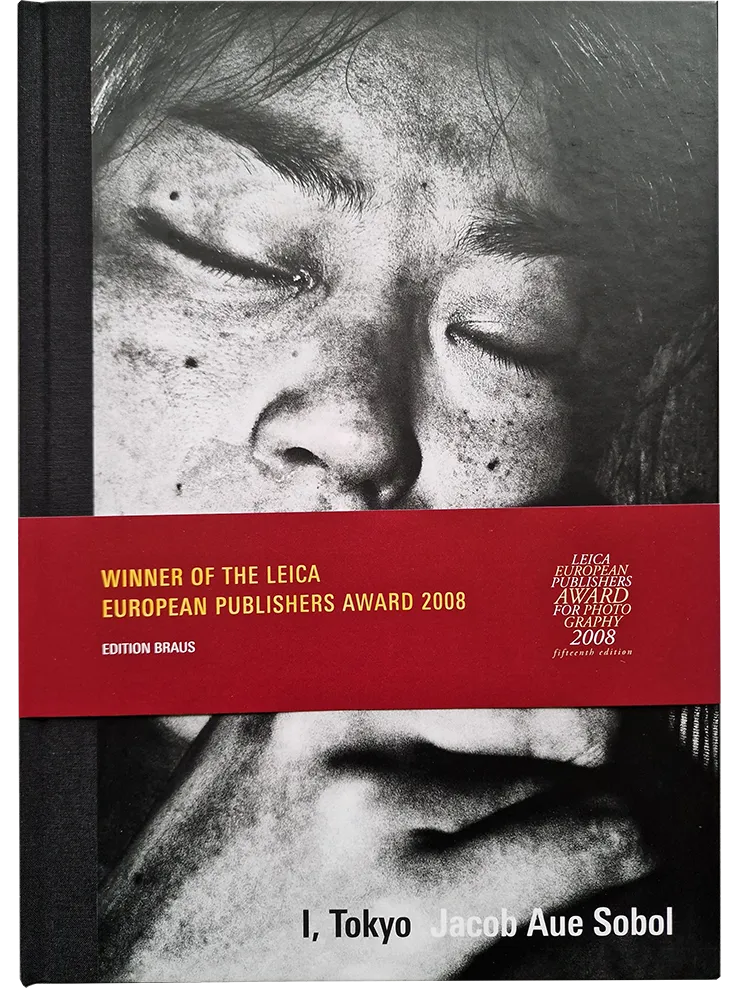


I, Tokyo documents Sobol's roughly 18-month stay in Tokyo starting in 2006. He arrived feeling anonymous and cut off from the city, struck by the silence of the commute, the lack of eye contact, the sense of isolation in such a dense population, and used a pocket camera to work through that alienation. Rather than photographing landmarks or crowds, he went looking for "narrow paths and individual human presence": close, textured, often intimate images, weathered hands, foggy breath on glass, skin, gesture, shot spontaneously and instinctively rather than planned. The book traces his shift from feeling invisible in Tokyo to gradually making the city his own through the camera, arriving at something more like a contemplative, emotionally raw self-portrait of urban isolation than a documentary record of the place.
It follows the same diaristic, close-to-the-skin approach as his earlier acclaimed book Sabine, applied here to an unfamiliar foreign city instead of a personal relationship.

I, Tokyo documents Sobol's roughly 18-month stay in Tokyo starting in 2006. He arrived feeling anonymous and cut off from the city, struck by the silence of the commute, the lack of eye contact, the sense of isolation in such a dense population, and used a pocket camera to work through that alienation. Rather than photographing landmarks or crowds, he went looking for "narrow paths and individual human presence": close, textured, often intimate images, weathered hands, foggy breath on glass, skin, gesture, shot spontaneously and instinctively rather than planned. The book traces his shift from feeling invisible in Tokyo to gradually making the city his own through the camera, arriving at something more like a contemplative, emotionally raw self-portrait of urban isolation than a documentary record of the place.
It follows the same diaristic, close-to-the-skin approach as his earlier acclaimed book Sabine, applied here to an unfamiliar foreign city instead of a personal relationship.