
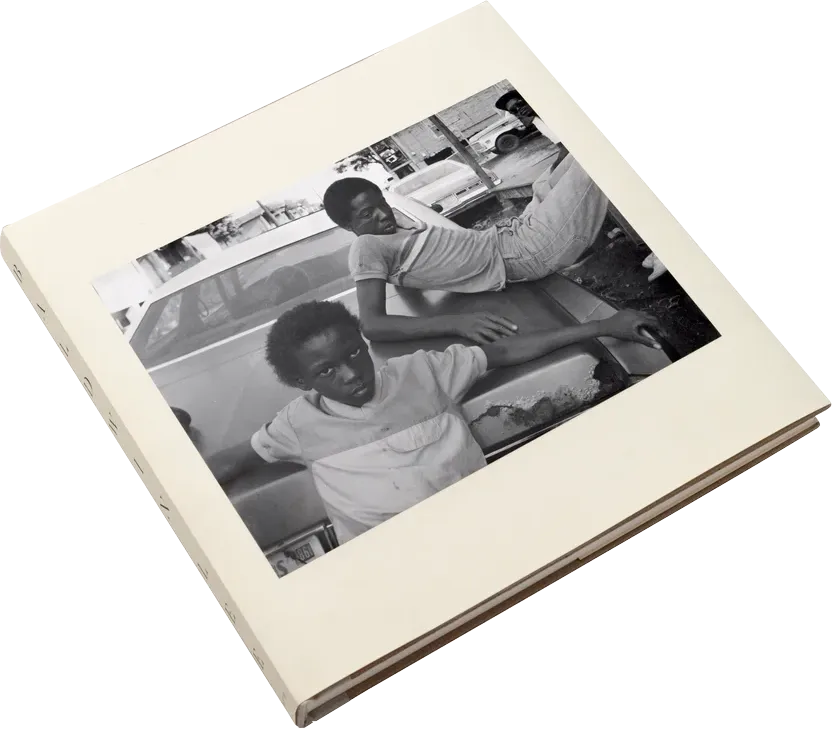
Hardcover with dust jacket
ISBN:
9798218088484



Baldwin Lee’s self-titled monograph serves as the definitive retrospective of a foundational four-year photographic campaign carried out across the American South between 1983 and 1989. Armed with a heavy 4x5 view camera, Lee traversed rural and small-town communities throughout Alabama, Mississippi, Tennessee, and Louisiana, capturing an unblinking and deeply dignified portrait of Black American life during a complex period of post-Civil Rights socio-economic transition.
The volume showcases a masterclass in large-format architectural rigor and humanist presence. Drawing directly from his lineage under Walker Evans, Lee frames his subjects not as transient sociological specimens, but as substantial figures embedded within their vernacular environments, porches, storefronts, roadside diners, and working-class neighborhoods. The compositions balance geometric discipline with striking psychological intimacy, rendering every individual with an arresting clarity of gaze and spatial weight.
Within the broader context of American photography, the book acts as a long-overdue corrective to the canon. Despite being produced with the backing of prestigious early fellowships, this massive body of work remained largely unexhibited and circulated outside mainstream institutional visibility for decades. The monograph effectively rescues these negatives from archival obscurity, cementing Lee’s distinct contribution to documentary art and establishing his documentation of the rural South as an essential pillar of twentieth-century American image-making.