
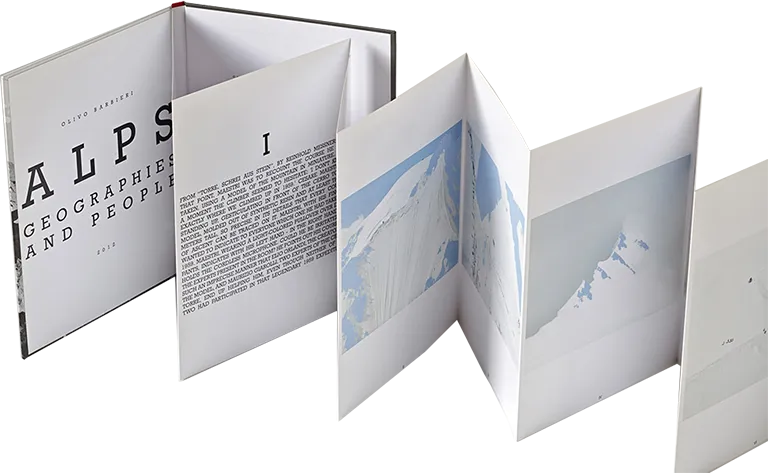
Boards leporello
ISBN:
9788898120208



Alps. Geographies and People emerges from a sustained aerial documentation project that interrogates how human interventions, tourism, infrastructure, and urban sprawl reshape the fragile topography of the European mountain range. Originating from Barbieri's broader investigation into contemporary geography and artificial perception, the series shifts the focus from untouched majesty to the complex interplay between pristine nature and anthropogenic footprint.
The publication is structured as a sweeping visual traverse across high-altitude landscapes, sequencing sweeping aerial plates that contrast traditional alpine villages and winding transit arteries with vast glacial recessions, ski resorts, and engineering works. By juxtaposing macro-scale geography with specific traces of human presence, the book maps the transformation of a legendary wilderness into a managed, heavily consumed tourist and industrial zone.
Physically, the volume is characterized by expansive landscape layouts, crisp high-resolution aerial reproduction, and precise tonal rendering that captures the blinding glare of snow and the stark, geometric imposition of human structures against raw stone.