
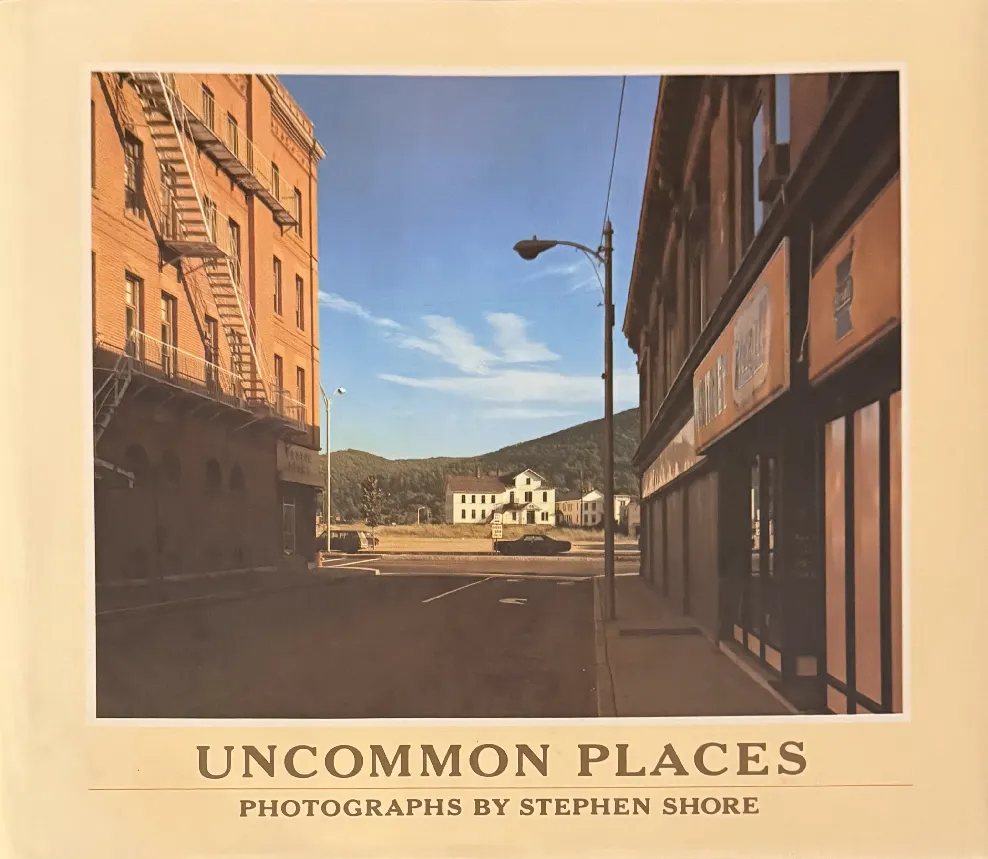
Hardcover with DJ
ISBN:
0893811017


Stephen Shore's Uncommon Places (1982) is a defining masterpiece of the New Topographics and New Color movements, originating from Shore's legendary cross-country road trips across the United States in the early 1970s.
Traveling primarily with an 8x5 view camera, and later a smaller format, Shore systematically documented the vernacular landscape of everyday America: parking lots, roadside diners, motels, main streets, and banal suburban architecture.
Rather than treating color photography as commercial or snapshot material, Shore applied the meticulous composition and deliberate pacing of traditional landscape and architectural photography to the modern commercialized environment. His images elevated the ordinary details of the American highway into profound cultural artifacts.
The work captures the banal architecture and visual clutter of the American roadside, gas stations, signage, storefronts, and motel rooms, finding geometric harmony and dignity in ordinary places. As a pioneer of color art photography (alongside contemporaries like William Eggleston), Shore used natural light and saturated palettes to record the specific, unassuming hues of late 20th-century consumer culture.
The series acts as a visual diary of transit, reflecting the vastness, isolation, and unglamorous reality of America between major metropolitan centers.
Uncommon Places fundamentally altered the trajectory of photography by proving that color and large-format cameras could capture high art in everyday, overlooked environments.
Stephen Shore's Uncommon Places (1982) is a defining masterpiece of the New Topographics and New Color movements, originating from Shore's legendary cross-country road trips across the United States in the early 1970s.
Traveling primarily with an 8x5 view camera, and later a smaller format, Shore systematically documented the vernacular landscape of everyday America: parking lots, roadside diners, motels, main streets, and banal suburban architecture.
Rather than treating color photography as commercial or snapshot material, Shore applied the meticulous composition and deliberate pacing of traditional landscape and architectural photography to the modern commercialized environment. His images elevated the ordinary details of the American highway into profound cultural artifacts.
The work captures the banal architecture and visual clutter of the American roadside, gas stations, signage, storefronts, and motel rooms, finding geometric harmony and dignity in ordinary places. As a pioneer of color art photography (alongside contemporaries like William Eggleston), Shore used natural light and saturated palettes to record the specific, unassuming hues of late 20th-century consumer culture.
The series acts as a visual diary of transit, reflecting the vastness, isolation, and unglamorous reality of America between major metropolitan centers.
Uncommon Places fundamentally altered the trajectory of photography by proving that color and large-format cameras could capture high art in everyday, overlooked environments.

Stephen Shore's Uncommon Places (1982) is a defining masterpiece of the New Topographics and New Color movements, originating from Shore's legendary cross-country road trips across the United States in the early 1970s.
Traveling primarily with an 8x5 view camera, and later a smaller format, Shore systematically documented the vernacular landscape of everyday America: parking lots, roadside diners, motels, main streets, and banal suburban architecture.
Rather than treating color photography as commercial or snapshot material, Shore applied the meticulous composition and deliberate pacing of traditional landscape and architectural photography to the modern commercialized environment. His images elevated the ordinary details of the American highway into profound cultural artifacts.
The work captures the banal architecture and visual clutter of the American roadside, gas stations, signage, storefronts, and motel rooms, finding geometric harmony and dignity in ordinary places. As a pioneer of color art photography (alongside contemporaries like William Eggleston), Shore used natural light and saturated palettes to record the specific, unassuming hues of late 20th-century consumer culture.
The series acts as a visual diary of transit, reflecting the vastness, isolation, and unglamorous reality of America between major metropolitan centers.
Uncommon Places fundamentally altered the trajectory of photography by proving that color and large-format cameras could capture high art in everyday, overlooked environments.