
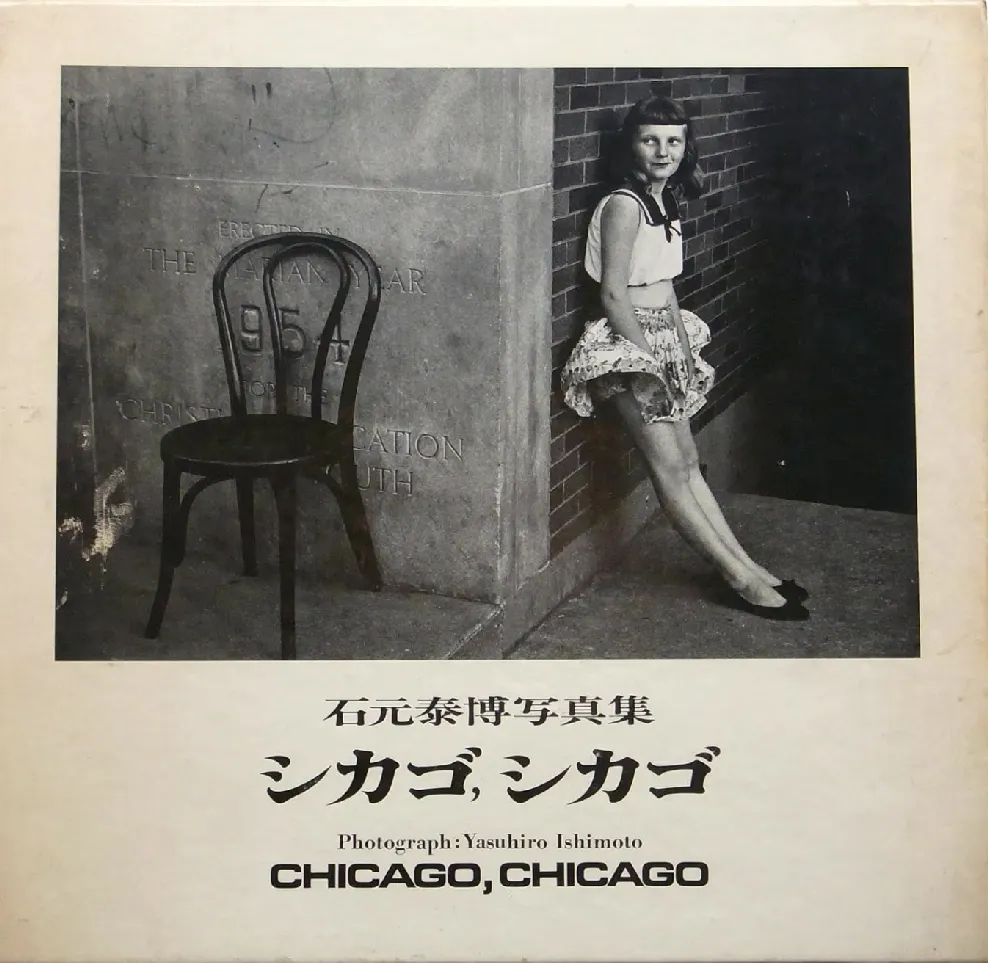
Slipcased boards
ISBN:



Yasuhiro Ishimoto’s Chicago, Chicago, first published in 1969, stands as a landmark monograph that merges the rigorous modernist design principles of the New Bauhaus with a deeply humanistic vision of urban space. Having studied under Aaron Siskind and Harry Callahan at the Institute of Design in Chicago, Ishimoto brought a sophisticated understanding of visual rhythm, architectural geometry, and graphic abstraction to his adopted American metropolis.
The monograph presents a masterclass in spatial choreography, contrasting the massive, grid-like steel and stone facades of downtown Chicago with the intimate, unscripted moments of everyday street life unfolding in the neighborhoods and along Lake Michigan. Ishimoto utilizes dramatic diagonals, stark contrasts of light and shadow, and precise architectural framing to transform ordinary urban elements, stairs, windows, paving stones, and structural steel, into dynamic compositions that oscillate between pure abstraction and social documentation.
Within Ishimoto’s broader oeuvre, Chicago, Chicago represents a defining synthesis of his dual cultural background, wedding Japanese spatial minimalism with the kinetic energy of post-war American street photography.