SOLD
Copyright ©
Brassaï
or applicable right holders.
Poster


Other impressions of the cropped image are in the permanent collections of MOMA, NY (object # 2524.1967), the Centre Pomidpou, Paris (AM 2003-5 (34)) and SFMOMA.
This image has been included in numerous publictions: The Secret Paris of the 1930s, Pantheon, 1976; Brassaï, The Museum of Modern Art, 1968, p. 19; Brassaï,
Le Paris secret des années 30, Gallimard, 1976, p. 79; Brassaï, Paris tendresse, Editions Hoëbeke, 1990, p. 55; Borja-Villel, ed., Brassaï, Fundació Antoni Tàpies, 1993, cat. no. 72, p. 135; Sayag and Lionel-Marie, eds., Brassaï: The Monograph, Little, Brown and Co., 2000, p. 83 and Brassaï, Retrospective, Centre Pompidou, 2000, ISBN 9782020398459

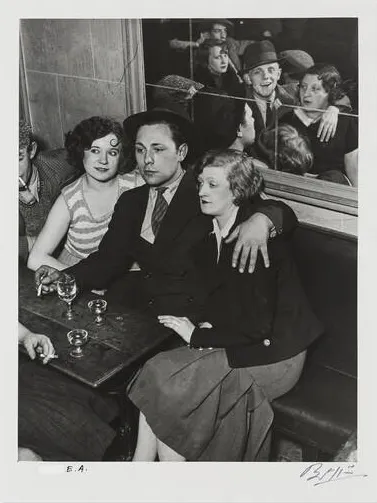
Brassaï’s Groupe Joyeux au bal musette, rue de Lappe operates as a definitive document of the Parisian nocturnal underworld during the interwar period. Wandering the city's working-class dance halls, cafes, and brothels, Brassaï immersed himself in the unfiltered social fabric of the night. This specific image captures the raw, lively atmosphere of a bal musette, environments that functioned as mixing grounds for street figures, laborers, and bohemian artists.
The inclusion of the mirror in the background of the frame is a crucial structural device that completely alters the spatial dynamic of the photograph. Brassaï frequently utilized mirrors in his nocturnal interiors to fracture the tight spaces of the dance halls and cafes, effectively doubling the depth of the room and creating a complex picture-within-a-picture. The woman on the right, locking eyes with the characters seen in the reflection (likely the woman to the left of the reflection), introduces a compelling psychological layer to the otherwise festive group. Instead of the entire cast simply reacting to the sudden burst of the camera’s flash, this mirrored gaze creates an internal, closed-loop observation outside the main cluster. Visually, the mirror acts as a secondary frame that breaks up the heavy darkness of the background wall and bounces the harsh magnesium light back into the scene, adding an exacting structural balance to the composition.
The photograph moves beyond mere social documentation, presenting a deeply atmospheric study of human connection and nightlife at the fringes of polite society, securing Brassaï's role as the premier observer of the city after dark.
The image relies on Brassaï’s pioneering mastery of artificial illumination. Utilizing magnesium flash powder in dim, smoke-filled interiors, he carved out the figures from the surrounding darkness with stark, directional light. The composition is tight and claustrophobic, forcing the viewer directly into the center of the joyful, interconnected group. The harsh flash creates high-contrast modeling on the subjects' faces and clothing, transforming the transient energy of the dance hall into a highly structured, almost sculptural arrangement of interlocking shapes and deep, anchoring shadows.
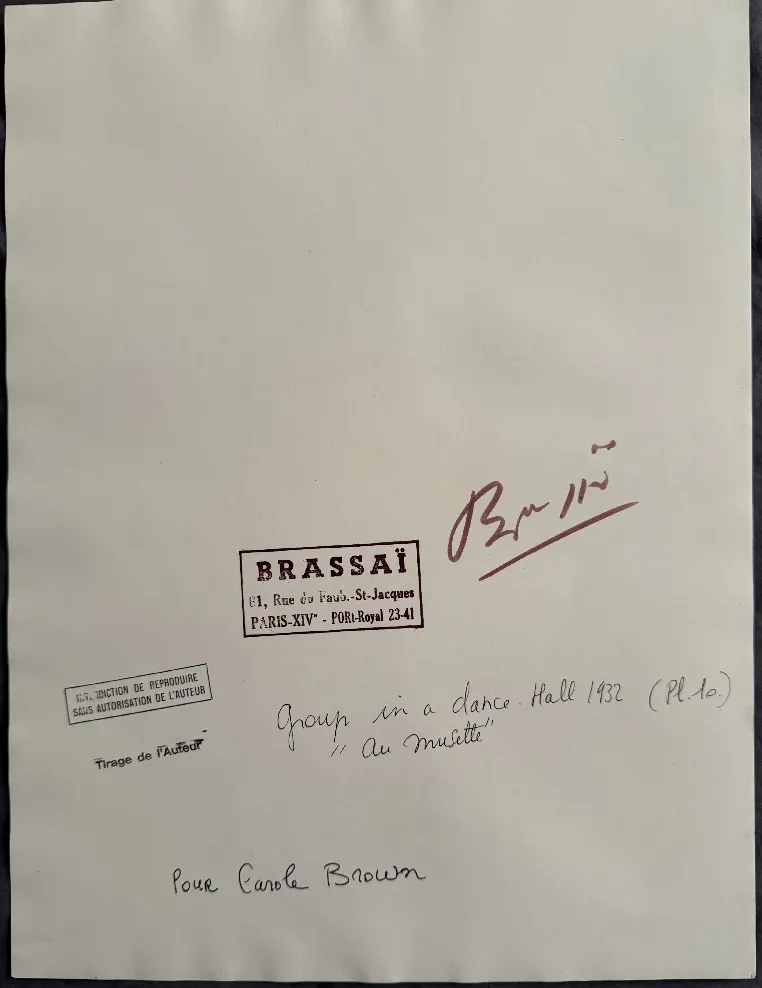
This particular image is a printer's proof uncropped image signed by Brassai on both the recto and verso. Final versions collected by institutions are usually landscape-cropped versions.
Other impressions of the cropped image are in the permanent collections of MOMA, NY (object # 2524.1967), the Centre Pomidpou, Paris (AM 2003-5 (34)) and SFMOMA.
This image has been included in numerous publictions: The Secret Paris of the 1930s, Pantheon, 1976; Brassaï, The Museum of Modern Art, 1968, p. 19; Brassaï,
Le Paris secret des années 30, Gallimard, 1976, p. 79; Brassaï, Paris tendresse, Editions Hoëbeke, 1990, p. 55; Borja-Villel, ed., Brassaï, Fundació Antoni Tàpies, 1993, cat. no. 72, p. 135; Sayag and Lionel-Marie, eds., Brassaï: The Monograph, Little, Brown and Co., 2000, p. 83 and Brassaï, Retrospective, Centre Pompidou, 2000, ISBN 9782020398459