SOLD
Copyright ©
Henry Wessel
or applicable right holders.
Poster


Other impressions of this image are in the permanent collections of MOCA, L.A. (accession # 97.2.37) and LACMA, L.A. (Accession # AC1998.216.34)

Other impressions of this image are in the permanent collections of MOCA, L.A. (accession # 97.2.37) and LACMA, L.A. (Accession # AC1998.216.34)
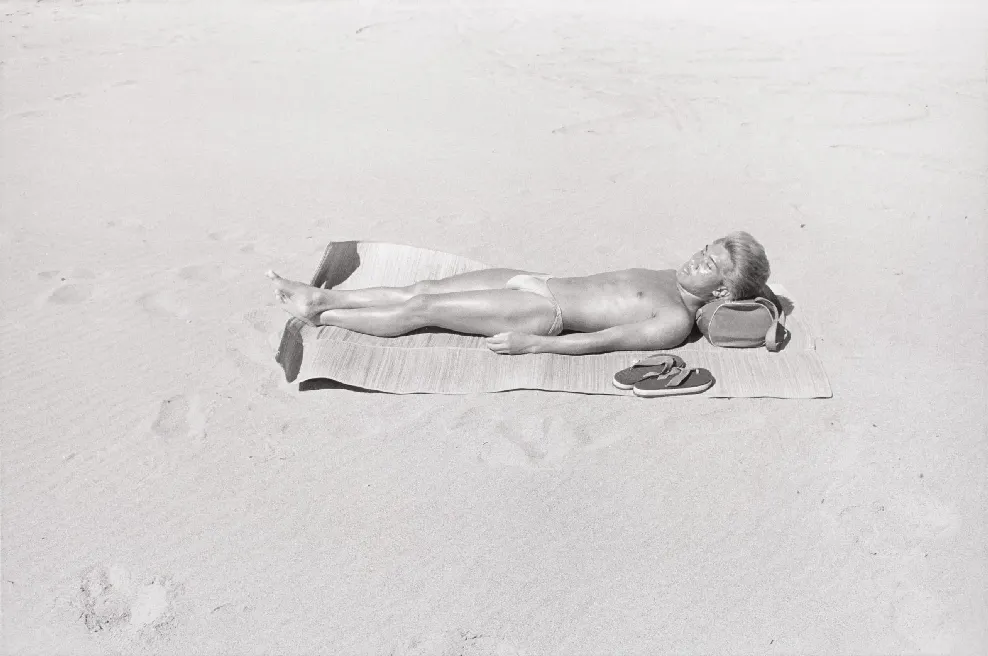
Henry Wessel’s Waikiki series originated from a sustained period of photography undertaken across multiple trips to Honolulu between the late 1970s and early 1980s. While Wessel is primarily celebrated for his deadpan, vernacular documentation of the American West and California suburbstypified by his inclusion in the landmark 1975 New Topographics exhibition), his excursion to Hawaii shifted his acute observational lens toward a hyper-commercialized tropical landscape.
Rather than producing exoticized travel photography or romanticizing the Pacific paradise, Wessel focused on the uneasy friction between mass tourism, modern concrete infrastructure, and the natural coastline. During this era, Waikiki was undergoing intense vertical development, transforming into a dense grid of high-rise hotels, asphalt, and crowded strips of sand. Wessel captured vacationers, sunbathers, and beachside leisure seekers against this backdrop, treating human figures not as focal points of joy, but as anonymous, almost incidental elements swallowed by glaring sunlight and heavy architectural geometry.
Other impressions of this image are in the permanent collections of MOCA, L.A. (accession # 97.2.37) and LACMA, L.A. (Accession # AC1998.216.34)