
SOLD
Copyright ©
Candida Hofer
or applicable right holders.


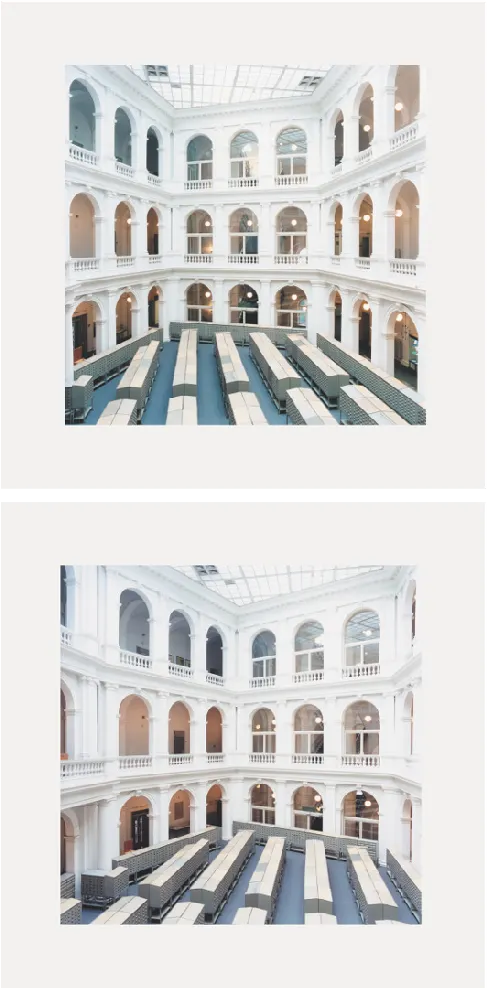
Universitätsbibliothek Hamburg, Diptych (2000/2002) is a notable work by Candida Höfer, created during the height of her systematic documentation of world libraries and institutional spaces.
The work documents the interior atrium of the State and University Library Hamburg (Carl von Ossietzky). Presented as a two-part diptych, Höfer captures the architectural symmetry, repeating tiers, and clean geometries of the building's central court.
In keeping with her signature Düsseldorf School aesthetic under Bernd and Hilla Becher, the interior is photographed completely devoid of people. The absence of readers or staff strips away narrative distraction, allowing the library to function as a visual archive, a monument to human knowledge, order, and collective memory preserved purely through its physical container.
Rather than offering a single monumental view, the diptych structure creates a subtle dialogic spatial tension. By shifting the camera angle or perspective slightly between the two frames, Höfer emphasizes the rhythm of the architectural framing, inviting the viewer to actively compare the balance of light, structural lines, and void.
Bare interiors is a recurring theme in the Bushwick sur Seine collection, which has been addressed in an article.


Universitätsbibliothek Hamburg, Diptych (2000/2002) is a notable work by Candida Höfer, created during the height of her systematic documentation of world libraries and institutional spaces.
The work documents the interior atrium of the State and University Library Hamburg (Carl von Ossietzky). Presented as a two-part diptych, Höfer captures the architectural symmetry, repeating tiers, and clean geometries of the building's central court.
In keeping with her signature Düsseldorf School aesthetic under Bernd and Hilla Becher, the interior is photographed completely devoid of people. The absence of readers or staff strips away narrative distraction, allowing the library to function as a visual archive, a monument to human knowledge, order, and collective memory preserved purely through its physical container.
Rather than offering a single monumental view, the diptych structure creates a subtle dialogic spatial tension. By shifting the camera angle or perspective slightly between the two frames, Höfer emphasizes the rhythm of the architectural framing, inviting the viewer to actively compare the balance of light, structural lines, and void.
Bare interiors is a recurring theme in the Bushwick sur Seine collection, which has been addressed in an article.