SOLD
Copyright ©
Mickalene Thomas
or applicable right holders.
Poster




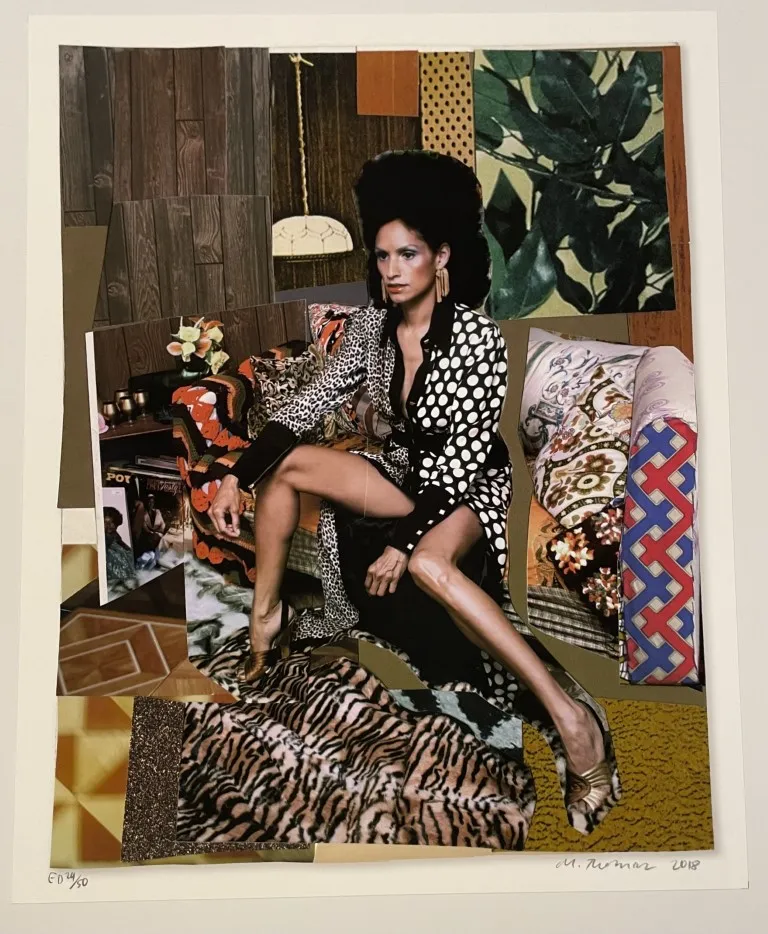
Mickalene Thomas’s Raquel Come to Me Two is a celebration of Black female subjectivity, desire, and the complex dynamics of the gaze. Centering on her frequent muse, collaborator, and wife, Raquel Chevremont, the image subverts the historical legacy of the Odalisque and classical Western portraiture by positioning a Black queer woman as the primary subject of beauty, agency, and power. Within Thomas’s broader oeuvre, this work represents a critical extension of her ongoing project to dismantle and reconstruct the art historical canon, replacing passive objectification with an empowered, self-possessed presence that confronts the viewer directly.
Aesthetically, the work is characterized by a dense, kaleidoscopic collision of domestic patterns, textures, and vibrant color fields that evoke the aesthetic interiors of the 1970s. The composition relies on a deliberate spatial flattening, a hallmark of Thomas’s practice, where the subject and the hyper-ornamented background merge into a cohesive, rhythmic surface. Translated here as a high-fidelity digital print on hot press paper, the piece successfully mimics the intricate, collaged layering of her monumental paintings while functioning as an autonomous graphic work. The interplay of bold geometric shapes against organic floral motifs creates a dynamic visual architecture that frames and amplifies Raquel’s commanding posture.