SOLD
Copyright ©
Viviane Sassen
or applicable right holders.
Poster


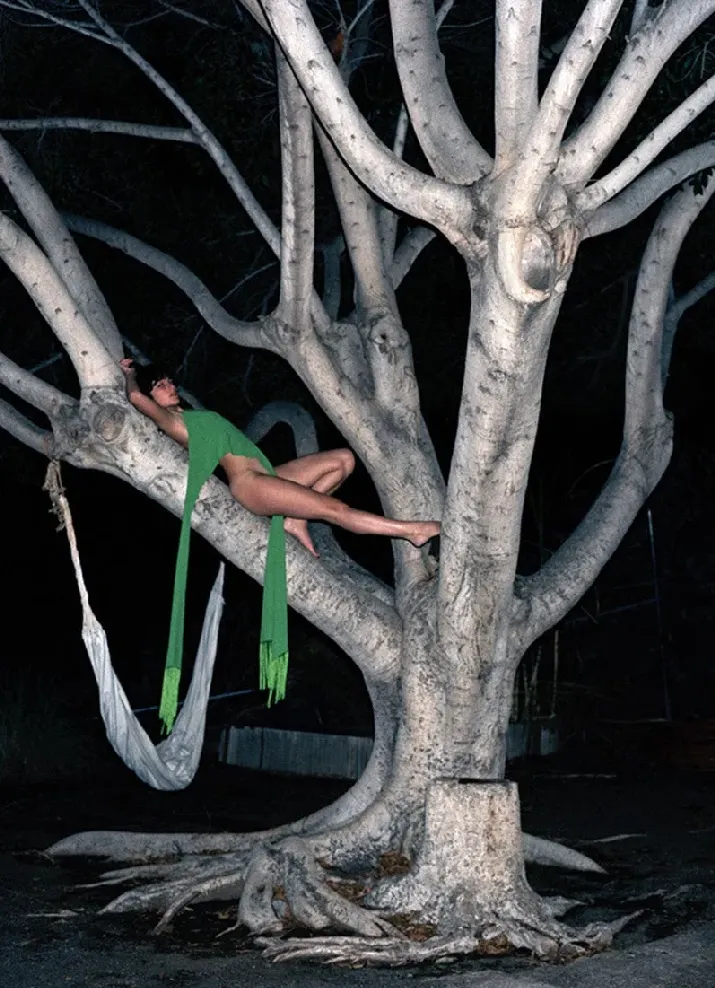
Sassen’s Frau Holle series borrows its title from the Brothers Grimm fairytale, invoking themes of winter, transformation, and subterranean subconscious depth. Created as Sassen turned her lens toward European landscapes and intimate studio studies following her celebrated African projects, the work explores the interplay between folklore, memory, and contemporary visual abstraction. Rather than offering a literal illustration of the fable, Sassen uses the archetype of Mother Holle, a figure presiding over both domestic labor and the wild forces of nature, to uncover psychological mystery within ordinary trees, shadows, and organic environments.
Aesthetically, the photograph operates through radical spatial compression, stark tonal contrast, and graphic abstraction. Viviane Sassen utilizes a harsh, direct flash to sever the foreground from the nocturnal void, desaturating the sprawling tree into a monochrome, sculptural grey while dropping the background into an impenetrable blackness. Against this muted architecture, the hyper-saturated lime green drape introduces an unmodulated color field that, lacking soft shadow gradients along its edges, reads visually like a two-dimensional collage element pasted onto the picture plane. By eliminating the horizon line and tightly cropping the frame, Sassen flattens three-dimensional depth, merging the model's limbs, the wooden branches, and the hanging white hammock into a single geometric composition where organic forms dissolve into pure structural motifs.