

Which art books, prints and posters are available by and about this artist? Here is a sample of items of interest to a typical collector:

Peter Keetman, German, 1916–2005, was a central figure in post-war European photography whose practice rigorously re-examined the boundaries between objective documentation and modernist abstraction. As a founding member of the avant-garde group fotoform in 1949, Keetman broke away from narrative photojournalism, championing a formalist visual language that emphasized graphic structure, micro-details, and light. His early career was defined by pioneering experiments with camera-less imagery, light graphics (Lichtgrafiken), and macro-studies of nature, most famously seen in his 1950 series Schwingungstropfen (Oscillating Drops), which transformed water droplets on shimmering surfaces into intricate, rhythmic geometric patterns.
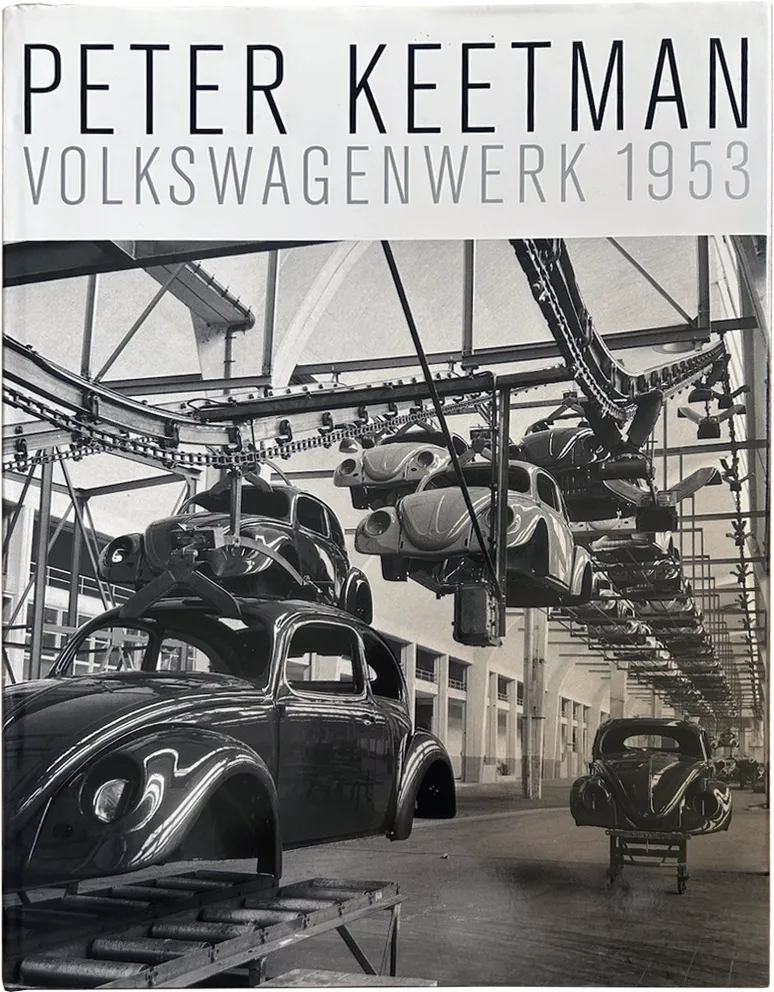
Throughout his body of work, Keetman consistently applied this experimental eye to the industrial landscape and the built environment. His definitive commercial and artistic achievement came with Volkswagenwerk 1953, a project where he spent a week photographing the Volkswagen assembly plant in Wolfsburg. Rather than capturing traditional factory vistas, he focused on repetitive industrial elements, stacked body panels, fenders, and chassis, turning mass production into a series of stark, rhythmic compositions. Similar formalist rigor runs through his extensive documentation of Munich’s post-war reconstruction, as well as his studies of modern architecture, where structural lines and stark shadows dominate the frame.
For the Bushwick sur Seine archive, Keetman’s practice serves as a vital cornerstone for understanding how formalist image-making elevates industrial and vernacular subjects into enduring sculptural artifacts. His ability to isolate graphic order from complex machinery demonstrates that the photographic object can bridge pure visual abstraction and physical reality.

Peter Keetman’s Volkswagenwerk 1953 operates as a defining document of Germany's post-war economic miracle (Wirtschaftswunder) and a masterclass in the application of modernist aesthetics to industrial subjects. Commissioned to spend a week photographing the Volkswagen factory in Wolfsburg, Keetman approached the birthplace of the iconic Beetle not merely as a site of mass production, but as a vast theater of mechanical geometry. As a founding member of the avant-garde fotoform group, he brought a highly subjective, rigorously formalist eye to the assembly line, bridging the gap between objective corporate documentation and striking photographic abstraction.
Aesthetically, the work relies on the rhythmic repetition of industrial forms and an exacting control of light and shadow. Rather than capturing broad, straightforward views of the factory floor, Keetman aggressively cropped his frames to focus on the abstract qualities of stacked metal fenders, endless rows of chassis, and the gleaming curves of unfinished car bodies. The resulting compositions utilize deep blacks and luminous metallic highlights to create a rigorous structural balance. This intense visual isolation transforms mundane car parts into graphic, almost musical patterns, emphasizing the precise choreography of modern manufacturing.