
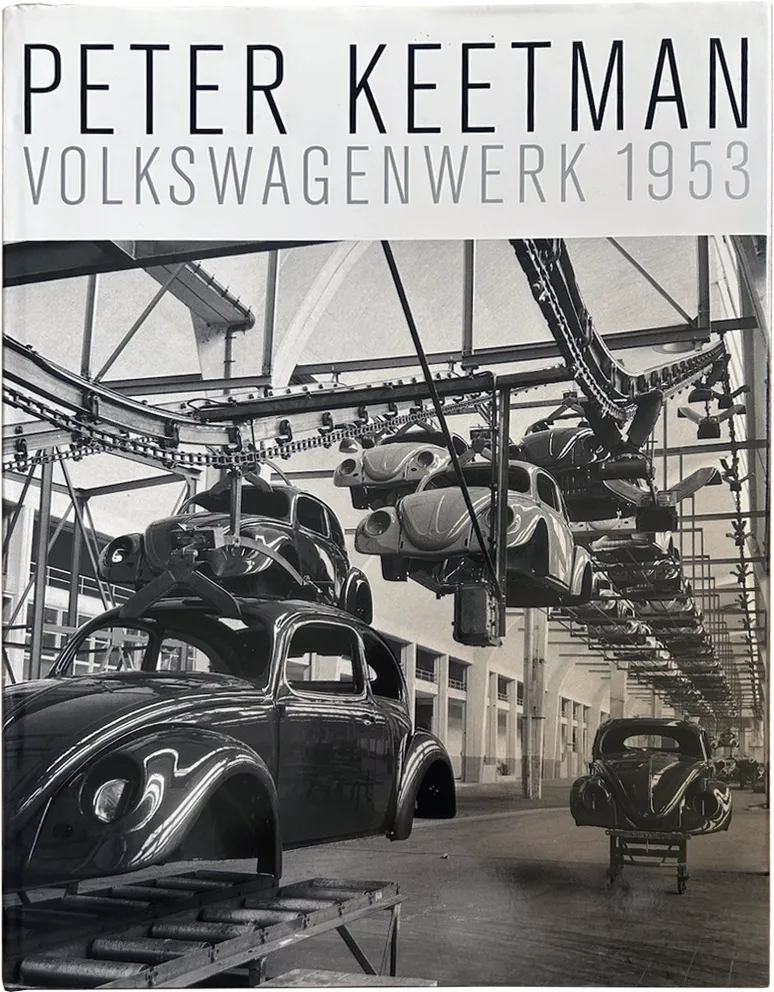
Hardcover with dust jacket
ISBN:
9783936646283


Peter Keetman’s Volkswagenwerk 1953 operates as a defining document of Germany's post-war economic miracle (Wirtschaftswunder) and a masterclass in the application of modernist aesthetics to industrial subjects. Commissioned to spend a week photographing the Volkswagen factory in Wolfsburg, Keetman approached the birthplace of the iconic Beetle not merely as a site of mass production, but as a vast theater of mechanical geometry. As a founding member of the avant-garde fotoform group, he brought a highly subjective, rigorously formalist eye to the assembly line, bridging the gap between objective corporate documentation and striking photographic abstraction.
Aesthetically, the work relies on the rhythmic repetition of industrial forms and an exacting control of light and shadow. Rather than capturing broad, straightforward views of the factory floor, Keetman aggressively cropped his frames to focus on the abstract qualities of stacked metal fenders, endless rows of chassis, and the gleaming curves of unfinished car bodies. The resulting compositions utilize deep blacks and luminous metallic highlights to create a rigorous structural balance. This intense visual isolation transforms mundane car parts into graphic, almost musical patterns, emphasizing the precise choreography of modern manufacturing.