




.webp)
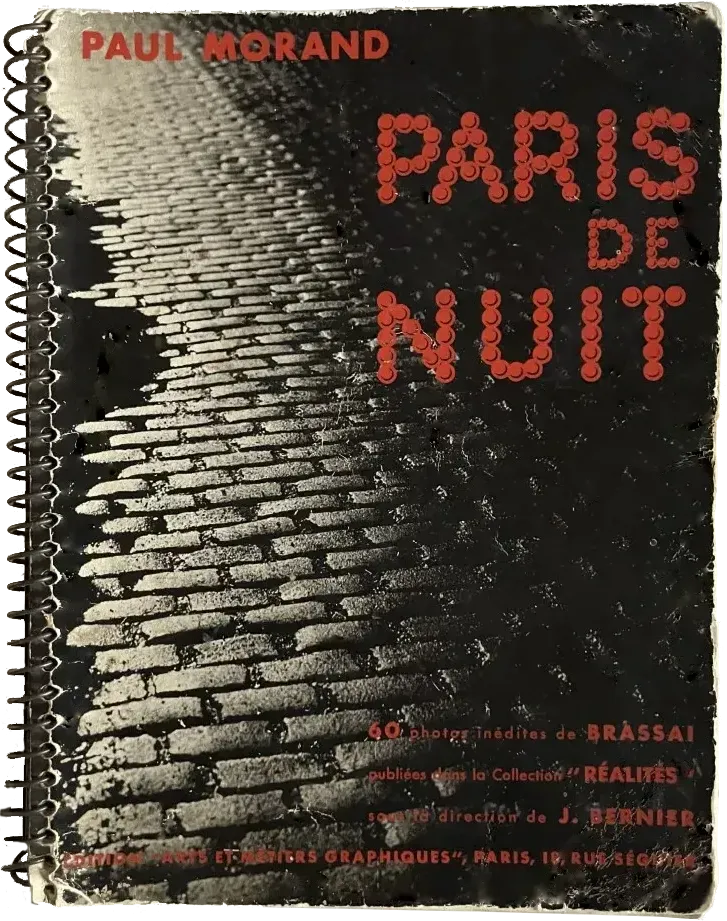
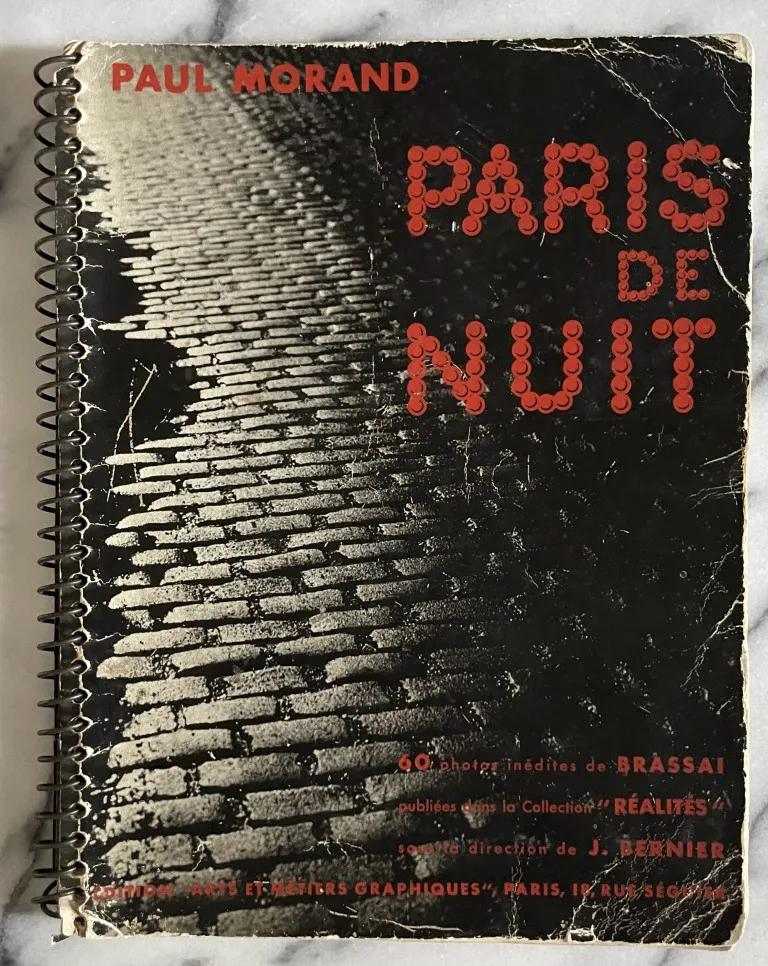
First published in December 1932 (bearing a 1933 imprint) by Éditions Arts et Métiers Graphiques, Paris de Nuit by Brassaï (Gyula Halász) is widely regarded as one of the most seminal photobooks in the history of the medium and probably this collection's most important book.
Arriving in Paris in 1924, Brassaï originally worked as a journalist and painter before picking up photography in the late 1920s partly inspired by his friend and mentor André Kertész Captivated by the nocturnal atmosphere of the capital, he spent two years wandering through dark alleys, riverbanks, high-society events, and subcultural haunts (cabarets, brothels, and late-night cafes).
He captured the city with a Voigtländer Bergheil camera mounted on a tripod, using long exposures timed by burning through cigarettes, along with Magnesium flashpowder for interiors. Guided by Lucien Vogel (founder of VU magazine), publisher Charles Peignot selected 62 photographs to form a cinematic, atmospheric sequence showcasing the contrast between Paris's glittering architectural lighting and its shadowy underworld
The book's legendary status is tied directly to its physical production, executed by printer Draeger Frères. It utilized deep heliogravure (photogravure), applying dense black inks that preserved rich shadow detail and luminous highlights. The photographs were printed across entire pages without margins, bleeding completely to the edges, which, at the time, was truly groundbreaking.
Published in a softcover format bound with an exposed metal spiral wire, the spiral punched directly through the image margins, allowing pages to lie completely flat and creating a tactile, industrial feel.
The book featured an introductory essay by French diplomat and writer Paul Morand.
Paris de Nuit established the night city as a primary photographic genre and cemented Brassaï's moniker, coined by Henry Miller as "the eye of Paris". It set a lasting benchmark for how image sequencing, layout, and print technology coalesce to make the photobook an autonomous art object.

First published in December 1932 (bearing a 1933 imprint) by Éditions Arts et Métiers Graphiques, Paris de Nuit by Brassaï (Gyula Halász) is widely regarded as one of the most seminal photobooks in the history of the medium and probably this collection's most important book.
Arriving in Paris in 1924, Brassaï originally worked as a journalist and painter before picking up photography in the late 1920s partly inspired by his friend and mentor André Kertész Captivated by the nocturnal atmosphere of the capital, he spent two years wandering through dark alleys, riverbanks, high-society events, and subcultural haunts (cabarets, brothels, and late-night cafes).
He captured the city with a Voigtländer Bergheil camera mounted on a tripod, using long exposures timed by burning through cigarettes, along with Magnesium flashpowder for interiors. Guided by Lucien Vogel (founder of VU magazine), publisher Charles Peignot selected 62 photographs to form a cinematic, atmospheric sequence showcasing the contrast between Paris's glittering architectural lighting and its shadowy underworld
The book's legendary status is tied directly to its physical production, executed by printer Draeger Frères. It utilized deep heliogravure (photogravure), applying dense black inks that preserved rich shadow detail and luminous highlights. The photographs were printed across entire pages without margins, bleeding completely to the edges, which, at the time, was truly groundbreaking.
Published in a softcover format bound with an exposed metal spiral wire, the spiral punched directly through the image margins, allowing pages to lie completely flat and creating a tactile, industrial feel.
The book featured an introductory essay by French diplomat and writer Paul Morand.
Paris de Nuit established the night city as a primary photographic genre and cemented Brassaï's moniker, coined by Henry Miller as "the eye of Paris". It set a lasting benchmark for how image sequencing, layout, and print technology coalesce to make the photobook an autonomous art object.