
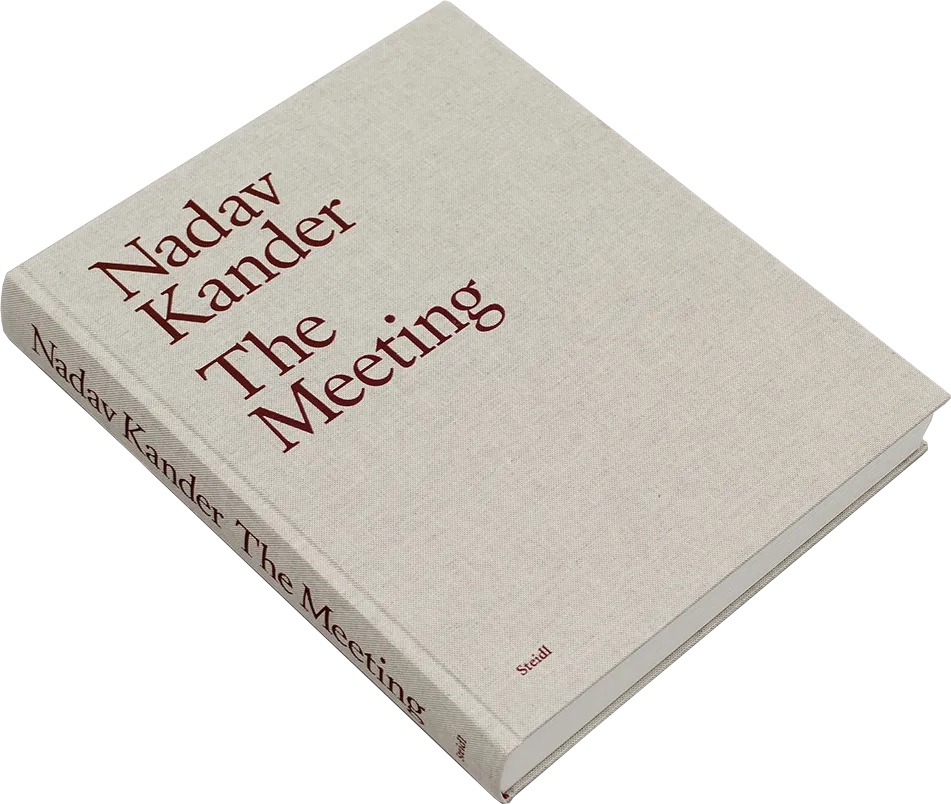
Clothed boards
ISBN:
9783958296152


The Meeting serves as Kander's first major publication dedicated entirely to portraiture, marking a significant pivot from the sweeping, melancholic landscapes that define much of his broader oeuvre. The project strips away the performative armor of his subjects, spanning global political figures, celebrated artists, and intimate family members. Rather than seeking to flatter or capture a straightforward likeness, Kander utilizes the controlled environment of the studio to access the inherent contradictions of the human condition. The series explores the delicate balance between revealing and concealing, searching for quiet vulnerability and the complex shadows that reside behind a public persona.
The book sequences these penetrating encounters without hierarchical distinction, placing world leaders alongside unknown subjects to create a leveling, democratic narrative of human emotion. Aesthetically, the work is defined by Kander’s masterful command of light and spatial isolation. The portraits, rendered in both muted, painterly color and stark black-and-white, frequently emerge from deep, enveloping darkness. Physically, this substantial, debossed clothbound volume published by Steidl functions as a heavy, tactile vessel. The immaculate, high-fidelity printing preserves the finest textural details of skin and fabric, isolating the sitters against neutral backgrounds to force a direct, unflinching engagement with the viewer.