
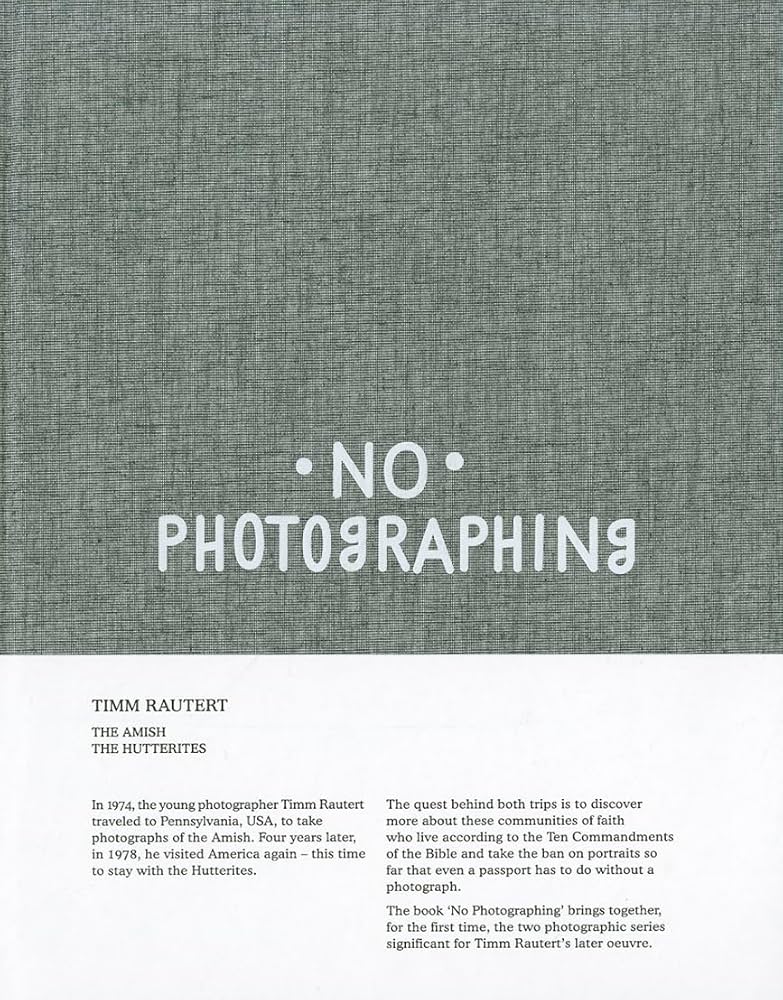
Hardcover without dust jacket, as issued
ISBN:
9783869303222


Timm Rautert’s No Photographing brings together two historically significant yet conceptually distinct photographic series that probe the ethics, boundaries, and restrictions of the photographic medium. Centered primarily on Rautert’s 1974 journey to Pennsylvania to document the Amish, a community whose religious beliefs explicitly forbid being photographed, the work investigates the friction between the impulse to capture and the subjects' fundamental right to invisibility.
Rautert approaches this documentary challenge not through clandestine intrusion, but by structuring the monograph as a physical inquiry into the limits of representation. The book's design interlocks these sensitive encounters with alternating sequences of blank pages, serving as a conceptual manifestation of the prohibitions, blockades, and ethical impasses that define the act of photographing a community withholding consent. By embedding these literal voids within the layout, Rautert transforms the absence of images into an active commentary on the power dynamics inherent in the camera's gaze.