
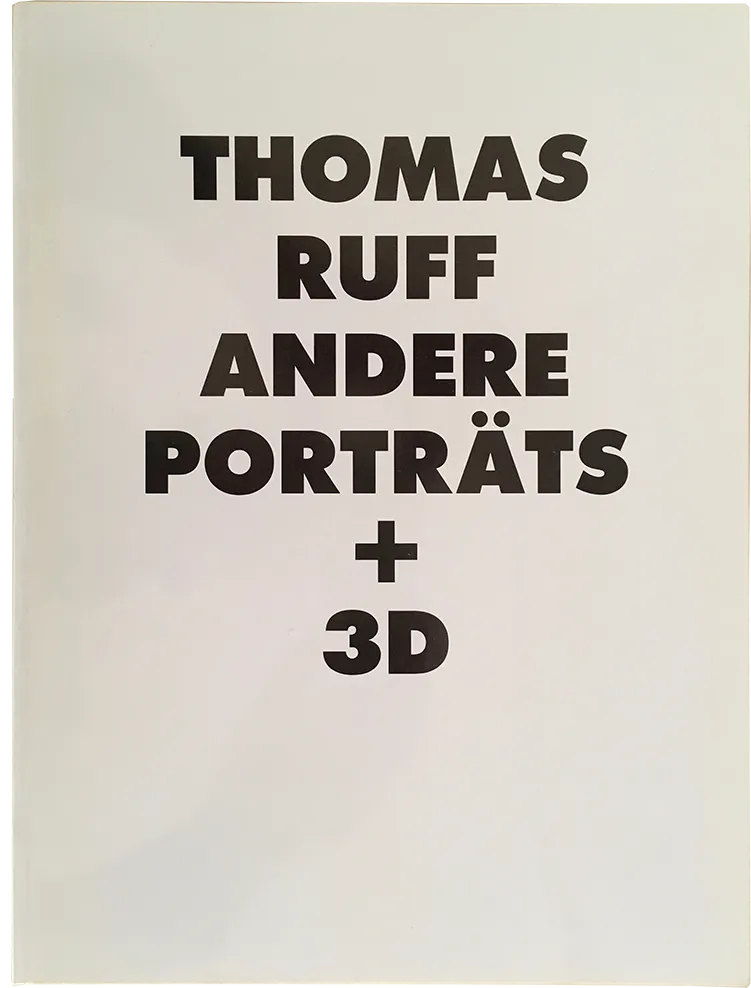
Softcover
ISBN:
9783893227723


Thomas Ruff’s Andere Porträts + 3D marks a radical conceptual departure from the deadpan portraiture that initially defined his position within the Düsseldorf School. Rather than capturing objective reality, Ruff acquired a 1970s Minolta Montage Unit, an optical device originally utilized by the German police to generate composite identikits of criminal suspects. By mechanically splicing together isolated facial features from his own earlier passport-style portraits, he synthesized entirely fictional identities. This project deeply interrogates the archival authority of the photograph, subverting its historical role as an instrument of state surveillance and verifiable truth to produce a haunting catalog of non-existent subjects.
Aesthetically, the work is characterized by the ghostly, disjointed visual artifacts inherent to the analog compositing process. The black-and-white images feature subtle misalignments, blurring, and overlapping contours where distinct male and female faces are unnervingly fused into a single visage. The addition of the "+ 3D" element elevates these uncanny composites into the realm of physical optics, utilizing anaglyph stereoscopic printing to force a disorienting spatial depth. The synthetic faces appear to hover off the page, challenging the viewer’s perception and emphasizing the artificial, constructed nature of identity when subjected to mechanical manipulation.