


In 1972, Stephen Shore left New York City and set out with a friend to Amarillo, Texas. He didn't drive, so his first view of America was framed by the passenger's window frame. He was taken aback by the fact that his experience of life as a New Yorker had very little in common with the character and aspirations of Middle America. Later that year he set out again, this time on his own, with just a driver's licence and a Rollei 35 - a point-and-shoot camera - to explore the country through the eyes of an everyday tourist.
The project was entitled American Surfaces, in reference to the superficial nature of his brief encounters with places and people, and the underlying character of the images that he hoped to capture. Shore photographed relentlessly and returned to New York triumphant, with hundreds of rolls of film spilling from his bags. In order to remain faithful to the conceptual foundations of the project, he followed the lead of most tourists of the time and sent his film to be developed and printed in Kodak's labs in New Jersey.
The result was hundreds and hundreds of exquisitely composed colour pictures, that became the benchmark for documenting our fast-living, consumer-orientated world. The corpus of his work - following on from Walker Evans' and Robert Frank's epic experiences of crossing America - influenced photographers such as Martin Parr and Bernd & Hilla Becher, who in turn introduced a new generation of students to Shore's work.
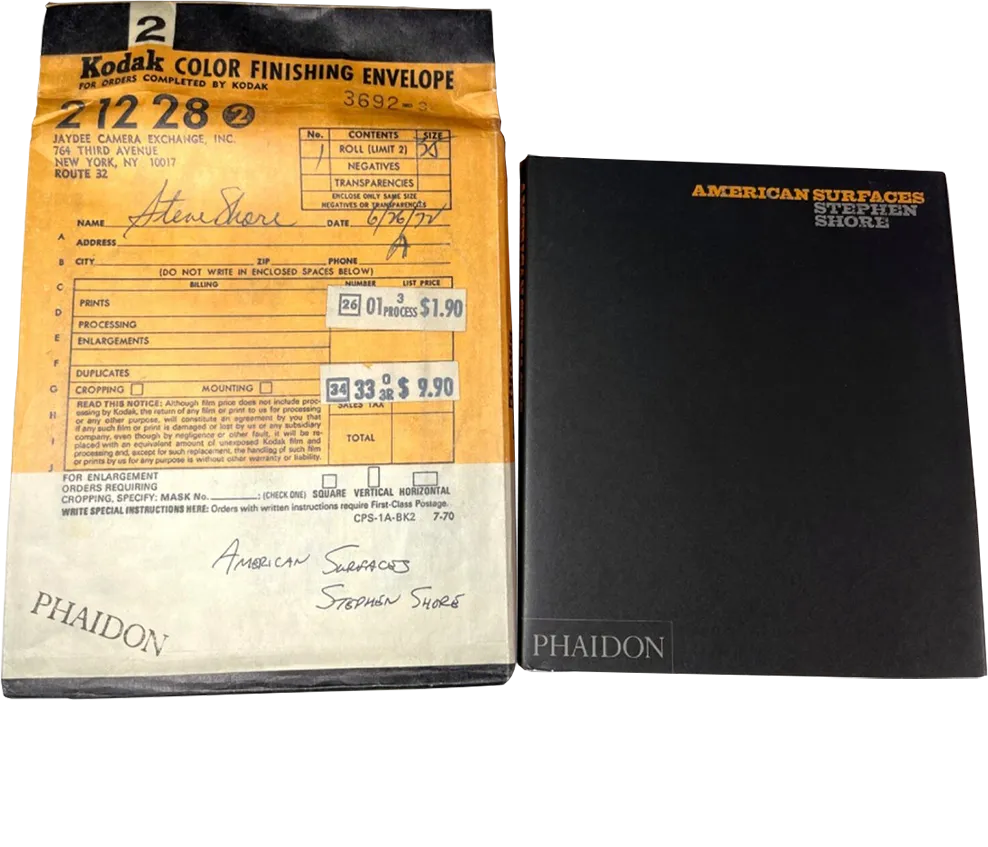
To pay homage to the original conceptual roots of the 1972 project, where Shore intentionally bypassed professional art labs and sent his film to a standard Kodak processing plant in New Jersey just like an ordinary tourist, Phaidon designed the first edition of this book to be enclosed in a specially designed plastic sleeve that replicated a vintage Kodak color processing order bag.

In 1972, Stephen Shore left New York City and set out with a friend to Amarillo, Texas. He didn't drive, so his first view of America was framed by the passenger's window frame. He was taken aback by the fact that his experience of life as a New Yorker had very little in common with the character and aspirations of Middle America. Later that year he set out again, this time on his own, with just a driver's licence and a Rollei 35 - a point-and-shoot camera - to explore the country through the eyes of an everyday tourist.
The project was entitled American Surfaces, in reference to the superficial nature of his brief encounters with places and people, and the underlying character of the images that he hoped to capture. Shore photographed relentlessly and returned to New York triumphant, with hundreds of rolls of film spilling from his bags. In order to remain faithful to the conceptual foundations of the project, he followed the lead of most tourists of the time and sent his film to be developed and printed in Kodak's labs in New Jersey.
The result was hundreds and hundreds of exquisitely composed colour pictures, that became the benchmark for documenting our fast-living, consumer-orientated world. The corpus of his work - following on from Walker Evans' and Robert Frank's epic experiences of crossing America - influenced photographers such as Martin Parr and Bernd & Hilla Becher, who in turn introduced a new generation of students to Shore's work.
To pay homage to the original conceptual roots of the 1972 project, where Shore intentionally bypassed professional art labs and sent his film to a standard Kodak processing plant in New Jersey just like an ordinary tourist, Phaidon designed the first edition of this book to be enclosed in a specially designed plastic sleeve that replicated a vintage Kodak color processing order bag.