
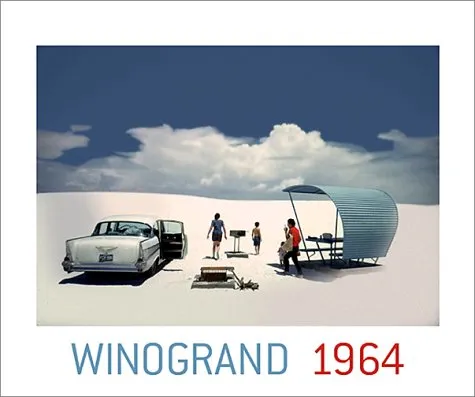


1964 (2002) focuses on a pivotal single year in the career of one of street photography's most legendary figures. Curated by Trudy Wilner Stack from the Garry Winogrand Archive at the Center for Creative Photography, the monograph compiles approximately 175-200 photographs taken during a single road trip across 14 states, funded by his first Guggenheim Fellowship.
In 1964, a year after JFK's assassination and at the dawn of the Vietnam War and Civil Rights movement, Winogrand embarked on a four-month journey across the United States.
While a handful of iconic images from this journey featured in MoMA's landmark 1967 New Documents exhibition, the vast majority of the photographs included in this volume remained unpublished and unseen until this book was assembled.
The work serves as a time capsule of mid-1960s America in transition, capturing state fairs, beaches, tourist sites, stock shows, and the New York World's Fair, balancing a naive, quirky frontier spirit with the rise of mass media, consumer culture, and underlying societal anxieties.
Winogrand's signature wide-angle, fast-paced street photography displays his characteristic empathy, dark humor, and sharp observation, offering a profound psychological portrait of public life during a period of national uncertainty.

1964 (2002) focuses on a pivotal single year in the career of one of street photography's most legendary figures. Curated by Trudy Wilner Stack from the Garry Winogrand Archive at the Center for Creative Photography, the monograph compiles approximately 175-200 photographs taken during a single road trip across 14 states, funded by his first Guggenheim Fellowship.
In 1964, a year after JFK's assassination and at the dawn of the Vietnam War and Civil Rights movement, Winogrand embarked on a four-month journey across the United States.
While a handful of iconic images from this journey featured in MoMA's landmark 1967 New Documents exhibition, the vast majority of the photographs included in this volume remained unpublished and unseen until this book was assembled.
The work serves as a time capsule of mid-1960s America in transition, capturing state fairs, beaches, tourist sites, stock shows, and the New York World's Fair, balancing a naive, quirky frontier spirit with the rise of mass media, consumer culture, and underlying societal anxieties.
Winogrand's signature wide-angle, fast-paced street photography displays his characteristic empathy, dark humor, and sharp observation, offering a profound psychological portrait of public life during a period of national uncertainty.