SOLD
Copyright ©
Eugene Atget
or applicable right holders.
Poster



Other impressions of this image are included in the permanent collections of the MOMA, New York (Object 1.1969.2458), the Metropolitan Museum, New York, (Object 1994.271) and the National Gallery of Art, DC (Object 2015.19.4312).
The Work of Atget, Vol. IV: Modern Times(Museum of Modern Art / John Szarkowski & Maria Morris Hambourg, 1985).
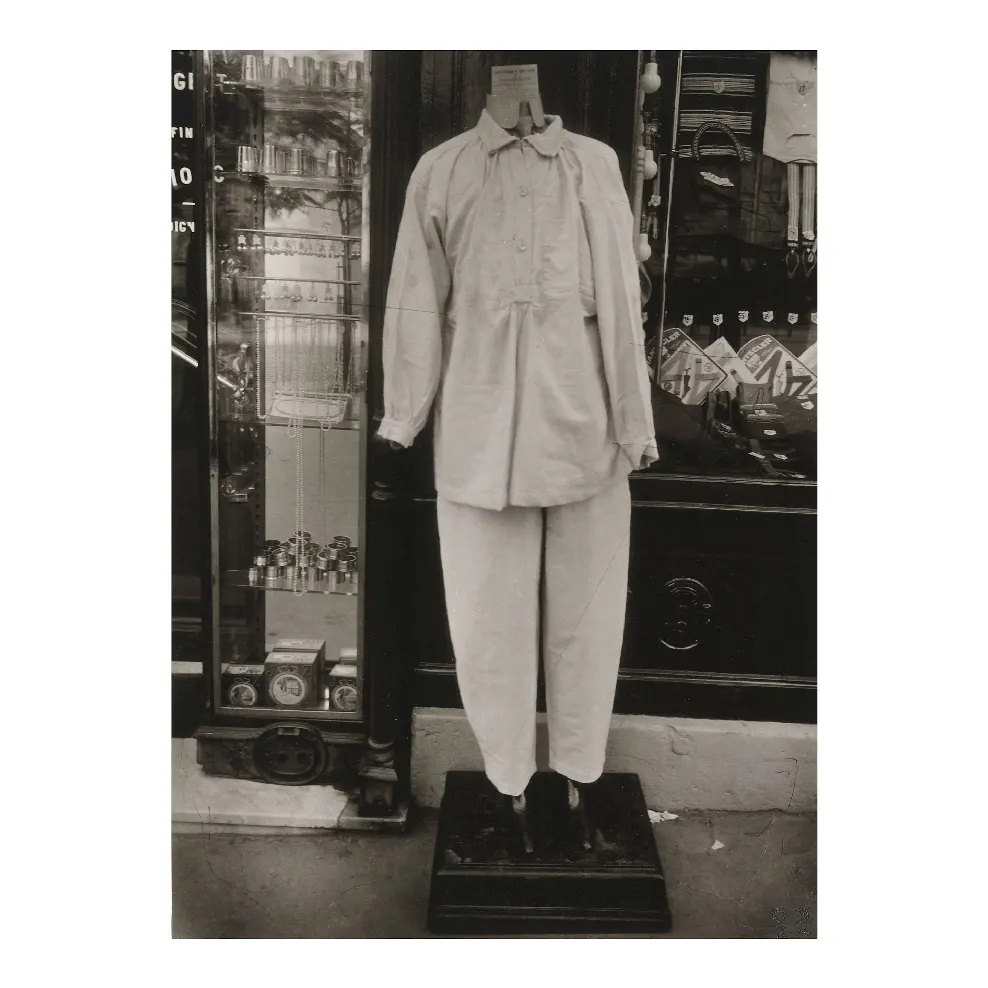
The photograph depicts a headless tailored mannequin wearing a structured suit, positioned on a wooden stand directly on the sidewalk outside a Parisian storefront. Rather than framing the figure behind display glass, Atget places the physical torso out in the open street, utilizing the dark window panel behind it to capture sharp reflections of the trees, street lamps, and 1920s architecture across the road. This creates an eerie, layered backdrop that blurs the boundary between the physical object and the reflected city.
Though Atget considered his work simple "documents for artists" (documents pour artistes), his late street and storefront compositions deeply influenced the Parisian avant-garde. Surrealists like Man Ray and André Breton embraced images like Mannequin, captivated by the uncanny, sculptural presence of a headless figure standing displaced on a public sidewalk.
This work serves as a key bridge from 19th-century commercial documentation to 20th-century visual modernism, laying the groundwork for street photographers like Walker Evans and Lee Friedlander, who later adopted reflective storefront surfaces and architectural juxtapositions as central motifs.
This print is number 15 in a portfolio of 20 photographs printed by Berenice Abbott in 1956 in an edition of 100.
Other impressions of this image are included in the permanent collections of the MOMA, New York (Object 1.1969.2458), the Metropolitan Museum, New York, (Object 1994.271) and the National Gallery of Art, DC (Object 2015.19.4312).
The Work of Atget, Vol. IV: Modern Times(Museum of Modern Art / John Szarkowski & Maria Morris Hambourg, 1985).


The photograph depicts a headless tailored mannequin wearing a structured suit, positioned on a wooden stand directly on the sidewalk outside a Parisian storefront. Rather than framing the figure behind display glass, Atget places the physical torso out in the open street, utilizing the dark window panel behind it to capture sharp reflections of the trees, street lamps, and 1920s architecture across the road. This creates an eerie, layered backdrop that blurs the boundary between the physical object and the reflected city.
Though Atget considered his work simple "documents for artists" (documents pour artistes), his late street and storefront compositions deeply influenced the Parisian avant-garde. Surrealists like Man Ray and André Breton embraced images like Mannequin, captivated by the uncanny, sculptural presence of a headless figure standing displaced on a public sidewalk.
This work serves as a key bridge from 19th-century commercial documentation to 20th-century visual modernism, laying the groundwork for street photographers like Walker Evans and Lee Friedlander, who later adopted reflective storefront surfaces and architectural juxtapositions as central motifs.
This print is number 15 in a portfolio of 20 photographs printed by Berenice Abbott in 1956 in an edition of 100.