SOLD
Copyright ©
Eugene Atget
or applicable right holders.
Poster


John Szarkowski and Maria Morris Hamburg, eds., The Work of Atget: Modern Times (MOMA, 1985), pl. 63; Clark Worswick, Berenice Abbott & Eugene Atget (Santa Fe, 2002), p. 36.
Another impression of this photograph is included in the MOMA collection (object 1.1969.1378).

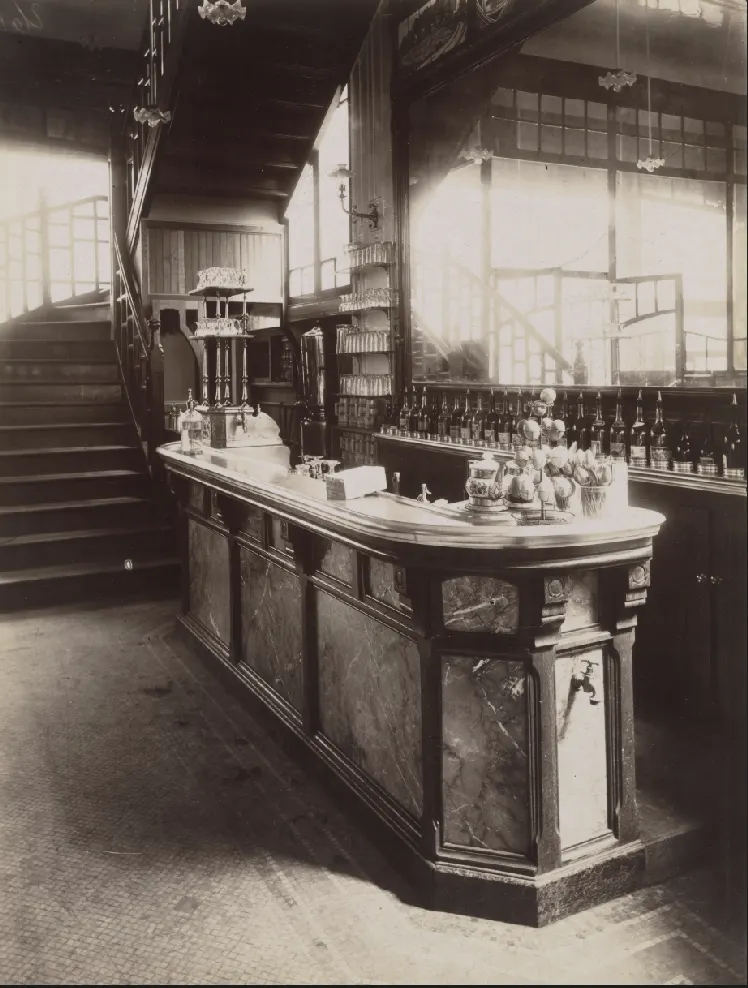
While Eugène Atget is often celebrated for his obsessive, antiquarian documentation of historic Paris, Marchand de vin, 15 rue Boyer, 1910 reveals his equally profound role as a modern observer of urban life. Positioned firmly in the present tense of early 20th-century commerce, this image captures the authentic, unvarnished reality of a working-class Parisian wine shop. Rather than romanticizing a vanishing past, Atget approaches the utilitarian storefront with a rigorous, almost encyclopedic objectivity that laid the essential groundwork for modern street photography and inspired the Surrealists.
Captured with his cumbersome large-format view camera, this image demonstrates Atget’s mastery of spatial geometry and atmospheric depth. The composition relies on a deliberate balance between the structured, utilitarian arrangement of the shop's interior, the stacked barrels, reflective glass, and signage, and the profound stillness resulting from his necessarily long exposure times. This specific gelatin silver print renders the subtle gradations of light and shadow with a striking clarity, amplifying the intricate textural details of the storefront that might have been softened in Atget’s original albumen printing process.
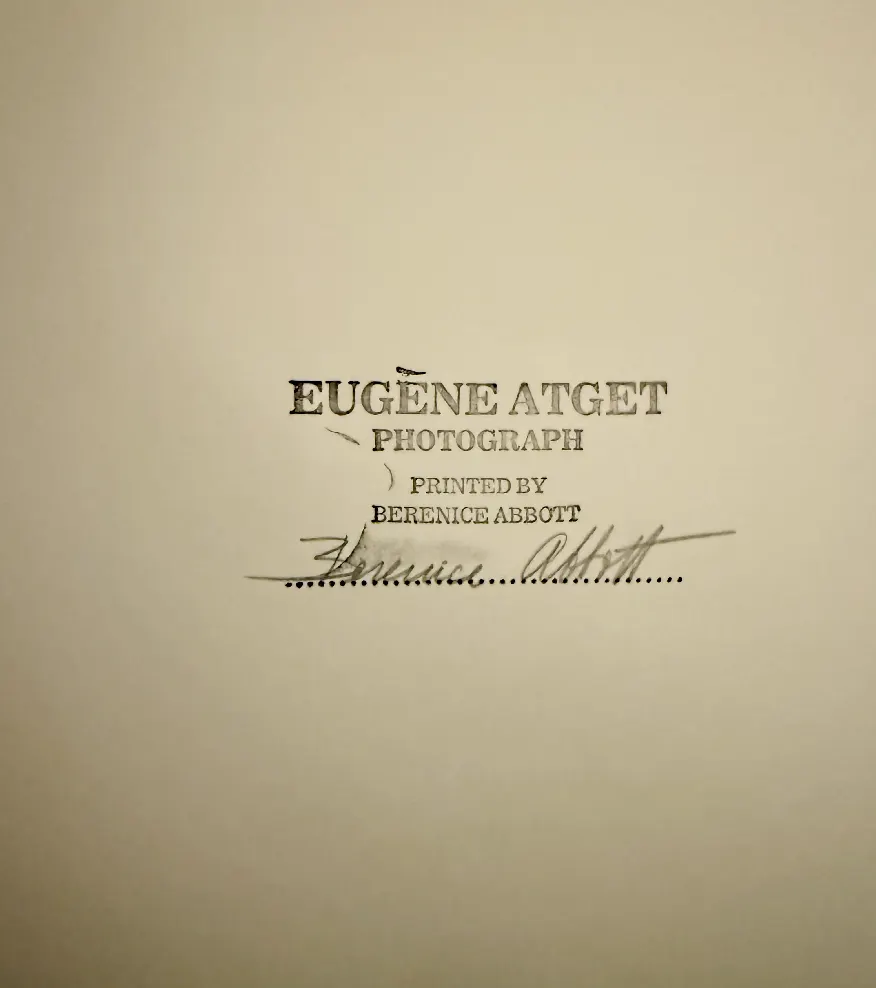
This particular photograph, acquired from the Harry Lunn estate, was printed by Berenice Abbott, likely in the 1970s.
John Szarkowski and Maria Morris Hamburg, eds., The Work of Atget: Modern Times (MOMA, 1985), pl. 63; Clark Worswick, Berenice Abbott & Eugene Atget (Santa Fe, 2002), p. 36.
Another impression of this photograph is included in the MOMA collection (object 1.1969.1378).