SOLD
Copyright ©
Lee Friedlander
or applicable right holders.
Poster


Exhibition Catalogue, Friedlander, The Museum of Modern Art, New York, 2005, p. 165, pl. 241.
Atget, Le Pionnier, Marval, 2000, p. 106.
Another impression of this photograph is included in the MOMA collection (object 1126.2000)

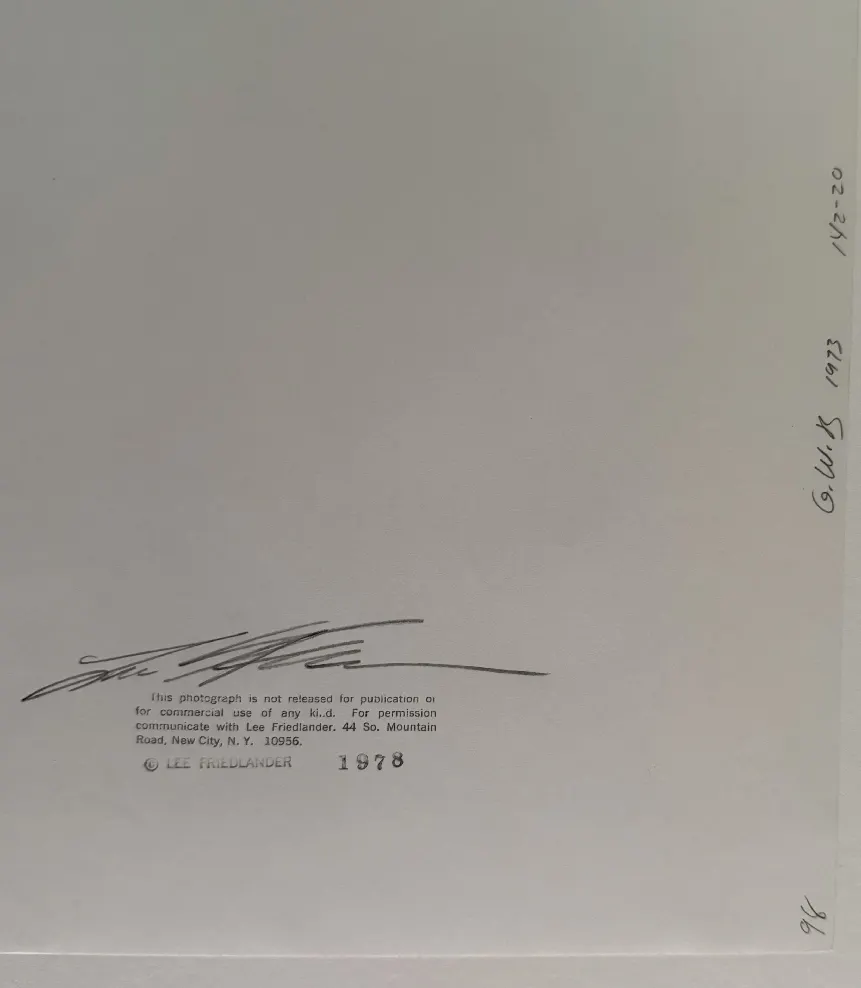
Exhibition Catalogue, Friedlander, The Museum of Modern Art, New York, 2005, p. 165, pl. 241.
Atget, Le Pionnier, Marval, 2000, p. 106.
Another impression of this photograph is included in the MOMA collection (object 1126.2000)
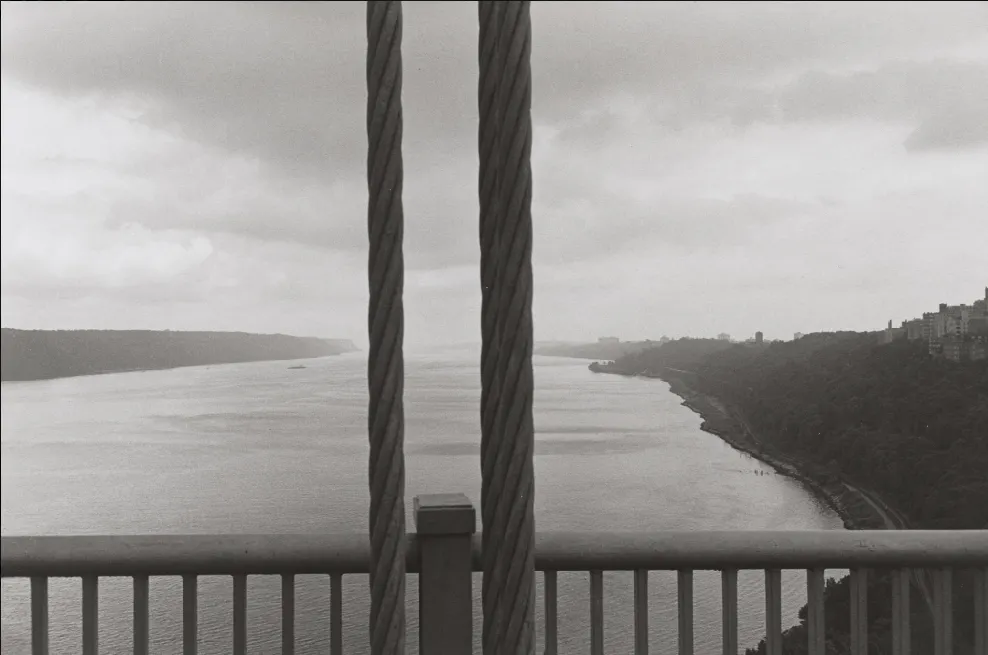
Lee Friedlander’s depiction of the George Washington Bridge fits seamlessly into his career-long deconstruction of the American social landscape and its monumental infrastructure. Diverging from the heroic or romanticized portrayals of mid-century engineering, Friedlander treats the massive suspension bridge not as a solitary marvel of progress, but as an integrated, often chaotic component of the everyday urban environment. The image reflects his broader typological interest in how public structures interact with the mundane realities of the modern cityscape, grounding the grandiosity of the bridge within the visual noise of its surroundings.
The composition relies on Friedlander’s signature use of spatial collapse and complex, multi-layered framing. By deliberately incorporating foreground obstacles, such as foliage, chain-link fencing, or street-level architecture, he flattens the distance between the viewer and the colossal steel structure. This crowding of the frame forces the rigid, geometric lines of the bridge’s suspension cables and towers to interact directly with the organic or disorganized elements of the immediate environment. The gelatin silver print medium emphasizes the stark graphic contrast and the tactile quality of the industrial masonry against the sky, turning a vast architectural expanse into a tightly structured, intricately balanced visual puzzle.
Exhibition Catalogue, Friedlander, The Museum of Modern Art, New York, 2005, p. 165, pl. 241.
Atget, Le Pionnier, Marval, 2000, p. 106.
Another impression of this photograph is included in the MOMA collection (object 1126.2000)