SOLD
Copyright ©
Lee Friedlander
or applicable right holders.
Poster


The American Monument, Eakins Press, 2017, full page, plate 37. And also in the first 1976 edition.
Other impressions of this photographs are included in the permanent collections of MOMA, NY (Object # 744.2000) and The Whitney Museum, NY (Same edition, numbered 42/50, Accession # P.2011.126.7).
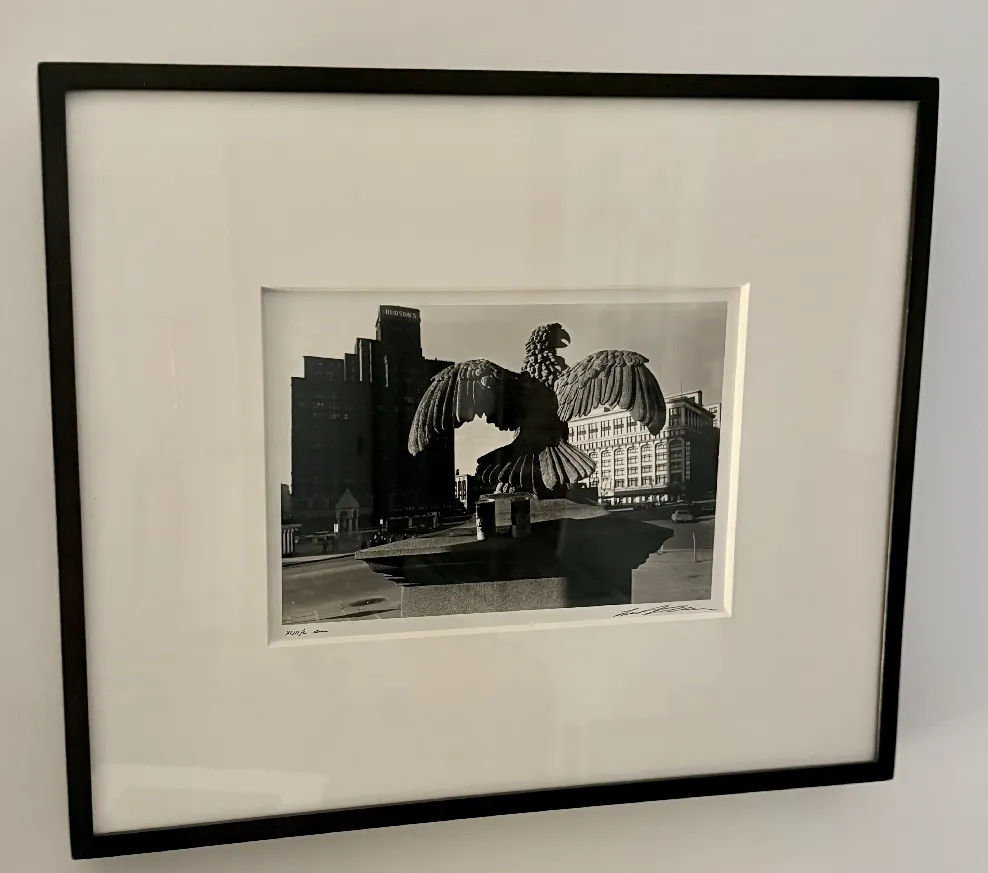
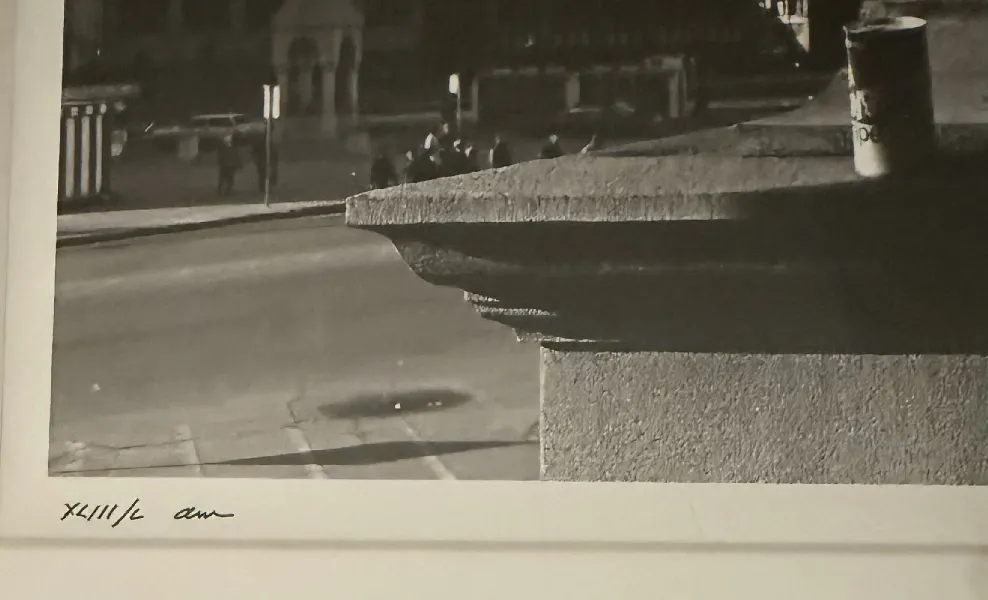

Lee Friedlander’s To Michigan Soldiers and Sailors emerges from his sweeping mid-1970s investigation into the American civic landscape, a massive undertaking that culminated in his seminal 1976 publication The American Monument. Moving beyond the romanticized or purely historical functions of public statuary, Friedlander approached these civic markers as active, often disjointed participants in the modern urban environment. The project reflects his career-long fascination with the chaotic, overlapping vernacular of American culture, treating grand historical memorials not as isolated objects of reverence, but as focal points around which the mundane realities of contemporary life, traffic, power lines, and commercial signage, constantly circulate.
Aesthetically, this image relies on Friedlander’s signature use of complex, multi-layered framing and deep focal planes. The composition deliberately collapses foreground and background, integrating the imposing stone and bronze structure of the memorial into the dense, cluttered visual field of the modern city. By utilizing a wide-angle lens and precise vantage points, he flattens the spatial dynamics, forcing the stoic historical figures to interact directly with the chaotic visual noise of the surrounding streetscape. The gelatin silver printing emphasizes the stark textural contrasts between the weathered masonry of the monument and the sharp, graphic lines of the encroaching urban infrastructure.
The American Monument, Eakins Press, 2017, full page, plate 37. And also in the first 1976 edition.
Other impressions of this photographs are included in the permanent collections of MOMA, NY (Object # 744.2000) and The Whitney Museum, NY (Same edition, numbered 42/50, Accession # P.2011.126.7).